Workplace Mental Health Programs and Benefits: A Complete Guide for Employers



Table of Contents
Mental health at work is no longer a soft topic sitting at the edge of HR conversations. It is a core business issue. According to the World Health Organization, an estimated 12 billion working days are lost every year due to depression and anxiety alone, costing approximately $1 trillion in lost productivity globally. That number does not include the compounding costs of turnover, absenteeism, or disengagement.
For employers, the stakes are clear. In workplaces that offer mental health resources, employees are significantly less likely to report that their productivity has suffered — 21% with access to resources compared to 38% without. The gap between companies that invest in employee wellbeing and those that don’t is becoming measurable and significant.
This guide walks through what workplace mental health programs actually are, why they matter for business performance, and how to build a strategy that works, whether you run a ten-person startup or a global enterprise.
What Are Workplace Mental Health Programs?
The terms “programs,” “benefits,” and “solutions” get used interchangeably, but they describe different things. Understanding the distinction helps employers make smarter investment decisions.
Mental Health Benefits
Coverage included in compensation packages.
Examples:
- Therapy coverage
- EAP access
- Mental health days
Mental Health Programs
Structured, ongoing initiatives within the workplace.
Examples:
- Manager training
- Wellness challenges
- Peer support networks
Mental Health Solutions
Tools and platforms that deliver or support care.
Examples:
- Mental health apps
- Teletherapy platforms
- Digital assessments
Employee mental health benefits are the foundation. Programs build culture around them. Solutions extend reach, especially for distributed or remote teams.
Why Mental Health Programs Matter for Employers
Absenteeism
Workers with fair or poor mental health are estimated to have nearly 12 unplanned absences annually, compared to 2.5 days for all other workers.
Presenteeism
Employees working while mentally depleted cost employers more than those who stay home.
Turnover
48% of U.S. employees have left a job for reasons tied to their mental health, and two-thirds of those departures were voluntary.
Productivity Loss
34% of employees felt their productivity suffered in 2024 because of their mental health.
Disengagement
Globally, employee engagement dropped to 21% in 2024, with the cost of lost productivity reaching $438 billion.
The business case for investing in corporate mental health programs is not difficult to make.
“Psychological safety is no longer a workplace perk — it is a business necessity.”
Workplace mental health insight
Deloitte‘s review of 26 studies shows employers can generate an average return of £4.70 for every £1 invested in improving workplace mental health. For universal programs that reach all employees, the return rises to £6.30 per £1 spent.
Key Benefits of Workplace Mental Health Programs
Benefits for Employees
- Access to professional mental health support
- Reduced stigma around seeking help
- Better work-life balance
- Feeling valued and supported by the organization
- Tools to manage stress and prevent burnout
Benefits for Employers
- Lower absenteeism and sick day usage
- Improved workforce productivity
- Higher retention and lower turnover costs
- Stronger employer brand and talent attraction
- Reduced healthcare and disability claim costs
According to Mind Share Partners’ 2025 report, employees who work at a company that supports their mental health are twice as likely to report no burnout or depression. That single data point connects directly to workforce productivity, engagement, and retention.
Types of Workplace Mental Health Programs
Employee Assistance Programs (EAP)
EAPs are the most common entry point for mental health benefits for employees. They provide confidential counseling, referrals, and support services, typically at no direct cost to the employee. Most EAPs also cover financial and legal counseling, which addresses a significant driver of workplace stress.
Therapy and Counseling Services
Direct access to licensed therapists, whether through insurance coverage or a dedicated platform, is increasingly the norm. According to EBRI, 97% of employers offered mental health coverage in 2025, up from 84% in 2019. The shift is real, but access and utilization are not always the same thing.
Mental Health Apps and Platforms
Digital tools have significantly expanded access, especially for remote teams. Employees are more interested in using digital tools to support their mental health than before the pandemic — 47% compared to 35%. Apps focused on mindfulness, stress management, and mental health tracking can complement clinical support.
Wellness Programs
Broader wellness initiatives, such as physical activity challenges, sleep programs, and nutrition support, indirectly contribute to mental well-being. They also tend to have higher participation rates than clinical programs, making them useful for building a culture of openness.
Manager Training Programs
This is one of the highest-impact investments an employer can make. Managers shape employees’ day-to-day experience more than any single benefit offering. Training them to recognize early signs of burnout, have supportive conversations, and connect employees to available resources creates a multiplier effect across the organization.
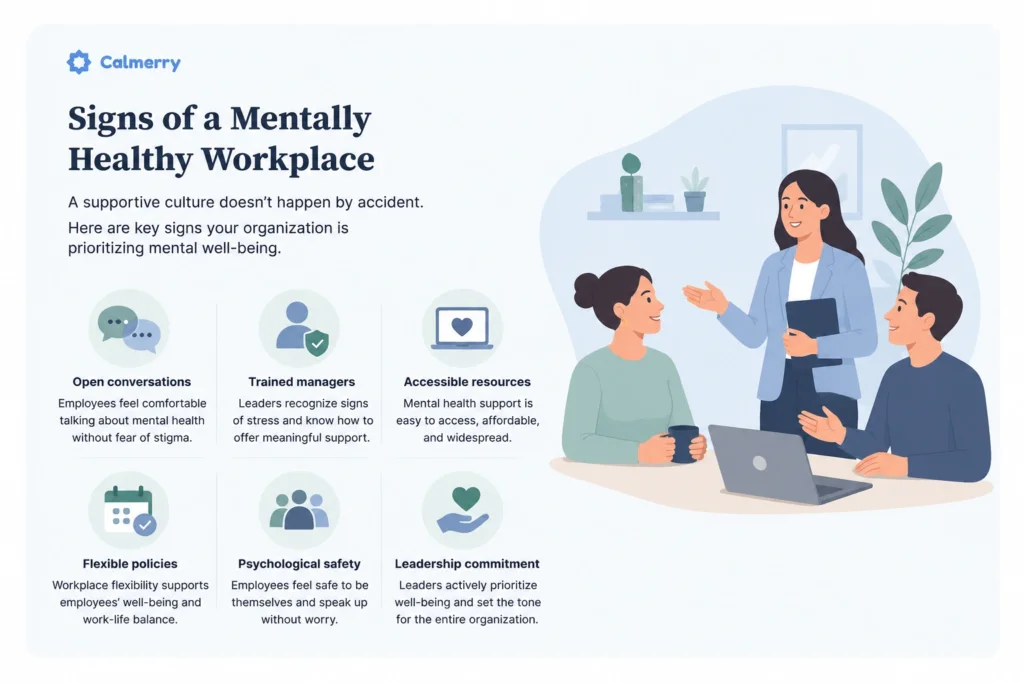
A mentally healthy workplace culture is built through consistent leadership, psychological safety, and accessible employee support.
Comparing Workplace Mental Health Program Types
Employee Assistance Programs (EAP)
Best for: All employees who need immediate support
Relative cost: Low
Impact level: Medium
Therapy and Counseling
Best for: Employees needing clinical care
Relative cost: Medium–High
Impact level: High
Mental Health Apps
Best for: Remote teams and high-volume access
Relative cost: Low
Impact level: Medium
Wellness Programs
Best for: Culture building and broad participation
Relative cost: Low–Medium
Impact level: Medium
Manager Training
Best for: Leadership development and team-level impact
Relative cost: Medium
Impact level: High
Preventive Programs
Best for: Long-term burnout prevention
Relative cost: Low–Medium
Impact level: High
Corporate Mental Health Programs: What Top Companies Offer
Google provides employees with on-site mental health professionals, access to licensed therapists through its benefits program, and a dedicated wellness team. The company also offers mental health days and has invested heavily in building psychological safety as a documented part of its team culture.
Microsoft has taken a public stance on mental health through leadership modeling. Senior executives have openly discussed their own mental health journeys, which has been linked to increased employee utilization of available support services. The company also provides free therapy sessions per year through its employee assistance program.
Deloitte ties a portion of HR performance metrics to EAP engagement, which signals organizational commitment rather than treating workplace mental health benefits as optional. Deloitte’s own research identifies leadership training and return-to-work programs as two of the highest-impact areas for maximizing ROI from mental health investment.
The common thread across these organizations is intentionality. Benefits are structured, measured, and aligned with the broader HR strategy, not offered as standalone perks.
“When leaders talk openly about mental health, employees seek support earlier — before burnout becomes a crisis.” | Workplace leadership insight
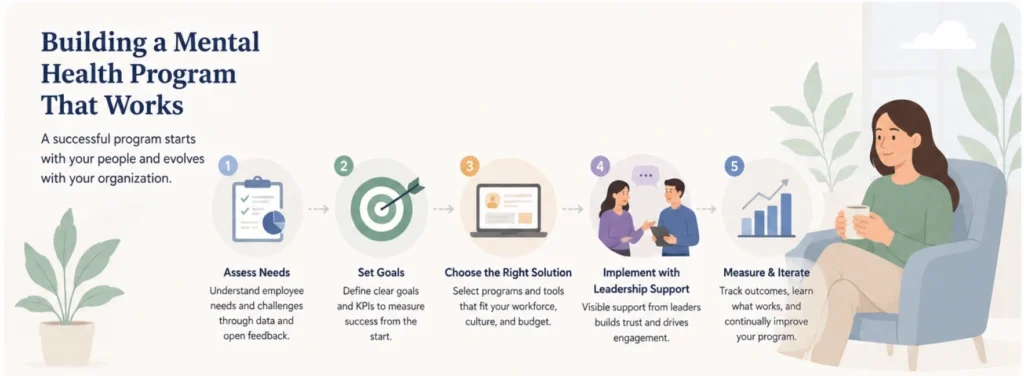
How to Build an Effective Workplace Mental Health Program
Building mental health programs in the workplace that actually work requires more than choosing a platform and announcing it in a company-wide email. Here is a practical framework.
Step 1: Assess Employee Needs
Start with data. Run anonymous surveys to understand what employees are experiencing: stress levels, barriers to accessing care, and awareness of existing benefits. Segment by team, location, and role if possible. The results will tell you where to focus first.
Step 2: Set Clear Goals and KPIs
Define what success looks like before launching anything. Common metrics include EAP utilization rates, absenteeism trends, employee satisfaction scores, and retention rates. Without a baseline, it is difficult to measure whether anything is working.
Step 3: Choose the Right Solution
Match the program to the workforce. A 200-person manufacturing company has different needs than a 50-person remote SaaS team. Consider accessibility, stigma, language support, and integration with existing benefits.
Step 4: Implement With Leadership Visibility
Roll out with visible support from leadership. When senior leaders talk openly about mental health, utilization of available programs rises. Culture shifts when behavior at the top changes.
Step 5: Measure ROI and Iterate
EAP Utilization Rate
Measures program awareness and accessibility.
Absenteeism Rate
Tracks changes in mental health-related sick days.
Employee Net Promoter Score (eNPS)
Measures overall employee satisfaction and engagement.
Voluntary Turnover Rate
Shows retention impact.
Disability Claims (STD/LTD)
Measures long-term cost reduction.
Manager Training Completion Rate
Reflects the depth of cultural adoption.
Online platforms like Calmerry offer structured access to licensed therapists and can integrate into an existing employee benefits package without requiring a large internal infrastructure to manage.
Mental Health Programs for Small Businesses
Budget constraints are real, but affordable options exist. Small businesses do not need enterprise-scale programs to make a meaningful difference.
Affordable and scalable options include:
- EAP through a benefits broker — Many small business health plans include basic EAP access at low or no added cost
- Mental health app subscriptions — Per-seat pricing on platforms like Headspace for Work or Calm Business is manageable at small team sizes
- Flexible time-off policies — Mental health days cost very little and signal a supportive culture clearly
- Free manager training resources — The American Psychological Association and Mental Health America both publish free employer toolkits
- Peer support networks — Trained internal advocates can create informal support channels that scale without ongoing cost
Mental health programs for small businesses do not have to be comprehensive from day one. Starting with one well-communicated benefit that employees actually use builds more trust than a full suite that goes unnoticed.
Mental Health Solutions for Startups
Fast-growing teams face a specific set of pressures: rapid change, unclear roles, long hours, and often a remote or hybrid culture that reduces informal social connections. Employee mental health solutions for startups need to be lightweight, scalable, and accessible from day one.
Practical starting points for startups:
- Build mental health days into the PTO policy from the start, not as an afterthought
- Use digital-first platforms that work across time zones and remote setups
- Train founders and early managers on how to recognize and respond to burnout signals
- Include mental health coverage in the benefits package before headcount grows — it is significantly easier to build the culture early
- Create psychological safety as a stated value, not just an implicit one
Common Mistakes Employers Make
Even well-intentioned programs fall short when they are poorly designed or poorly maintained. The most frequent mistakes include:
- One-time initiatives — A mental health awareness event in May is not a program. Sustainable impact requires year-round commitment.
- No measurement — Without tracking utilization, absenteeism, or satisfaction, it is impossible to know what is working.
- Ignoring managers — Programs that skip manager training miss the most influential layer of the employee experience.
- Low visibility — Benefits that are not communicated clearly and repeatedly go unused, regardless of their quality.
- Treating it as a perk rather than a strategy — Mental health programs that are disconnected from HR strategy rarely achieve lasting results.
How to Choose the Right Mental Health Solution
Use this checklist before committing to a program or platform:
- Company size — Does the solution scale to your headcount, both now and in 12 months?
- Budget — What is the total cost per employee, including implementation and ongoing management?
- Employee needs — Does the solution address the specific issues your workforce is experiencing?
- Accessibility — Is it available across devices, time zones, and languages relevant to your team?
- Integration — Does it connect to your existing HR systems and benefits infrastructure?
- Measurement — Does the vendor provide utilization data and outcome reporting?
- Clinical quality — For therapy-based solutions, what are the practitioners’ credentials?
- Stigma reduction — Is the experience designed to feel welcoming rather than clinical?
FAQ
What are workplace mental health programs?
Workplace mental health programs are structured initiatives employers use to support employees’ psychological well-being. They may include EAPs, therapy coverage, wellness initiatives, manager training, and mental health platforms.
What types of mental health programs can companies offer?
Common workplace mental health programs include EAPs, therapy and counseling services, mental health apps, wellness initiatives, manager training, and burnout prevention programs.
How much do workplace mental health programs cost?
Costs vary depending on the level of support provided. EAPs are often one of the most affordable options, while full clinical programs with dedicated providers require a larger investment but may deliver higher utilization and long-term outcomes.
Are workplace mental health programs worth it for employers?
Yes. Research consistently shows that investing in employee mental health can reduce absenteeism, improve retention, and strengthen productivity. Deloitte’s 2024 analysis found an average return of £4.70 for every £1 invested in workplace well-being initiatives.
What is the ROI of workplace mental health programs?
ROI depends on the type of program and employee participation. Reduced turnover, lower absenteeism, stronger engagement, and productivity improvements are among the most common business outcomes.
How do mental health programs improve employee productivity?
Mental health support helps employees manage stress earlier, reducing burnout and presenteeism — situations where employees remain at work but struggle to perform effectively.
What are the best mental health solutions for small businesses?
Affordable options for small businesses include EAP access through health plans, mental health app subscriptions, flexible PTO policies, and manager training resources.
How can employers choose the right mental health solution?
Organizations should evaluate solutions based on company size, workforce needs, accessibility, budget, reporting capabilities, and integration with existing HR systems.