Can Anxiety Cause Physical Harm? The Real Physical Effects of Anxiety on the Body


In this article
We have been raised on a diet of compartmentalization. Western medicine has long treated the human being like a duplex with soundproof flooring: the mind lives upstairs, dealing with thoughts, feelings of anxiety, and abstract fears, while the body lives downstairs, dealing with blood, bone, and tissue. We assume these neighbors rarely speak to one another.
But anyone who has ever felt the floor drop out from under them during a panic attack knows this is a lie.
You feel the tightness in your chest before you register the fear. Your stomach knots up before your brain can articulate why. When we whisper the question to ourselves late at night, “Can anxiety cause physical harm?“, we are usually hoping the answer is “no.”
We want to believe that the racing heart and the vertigo are just “in our heads,” harmless phantoms that can be dismissed with enough willpower.
But the uncomfortable reality, one that we often try to ignore in our hustle-obsessed culture, is that the body keeps the score. Anxiety and panic are not just emotional states; they are physiological events[highlight]. The impact of anxiety on the body is a hardwired circuit. The physical effects of this circuit overheating are not just a bad mood. They result in a very real, very physical problem.
How Anxiety Can Cause Physical Pain
We tend to view the physical symptoms of anxiety disorder as a glitch in our body. We tell ourselves to “calm down,” expecting everything to pass soon. But what if your body isn’t malfunctioning? What if it is doing exactly what it was designed to do, only at the wrong time?
To understand the question, “Can anxiety hurt your body?” we have to look at the mechanics of the stress response.
The Biological Cost: Stress Response and Heart Rate
When you perceive a threat, whether it’s a tiger in the bushes or a passive-aggressive Slack message from your boss, your amygdala pulls the fire alarm. This triggers the release of cortisol and adrenaline, creating an immediate physical response.
In this state of anxiety, your heart rate spikes to pump blood to your extremities. Your breathing quickens, and the digestion shuts down. In a primitive context, this prepares you to fight or flee. Once the threat is gone, the stress passes, and the body returns to homeostasis.
When High Levels of Stress Become Toxic
Here is the contrarian truth: [highlight]your body cannot distinguish between a physical threat and an emotional one. To your nervous system, a looming deadline feels biologically identical to a predator.
When high levels of stress become your baseline, the system never resets. The body to return to a resting state becomes impossible. Anxiety can cause your system to get stuck in overdrive.
When the effects on the body persist for months or years, you aren’t just “stressed.” You are driving a car with the parking brake on and the gas pedal floored. Eventually, the engine begins to smoke.
Common Anxiety Signs and Symptoms of Anxiety

In our push for resilience, we often ignore warning signs until our bodies react. Recognizing anxiety signs and symptoms is important from the very beginning.
In fact, the spectrum of symptoms is broader than we give it credit for.
Identifying Physical Symptoms of Anxiety Disorder
Anxiety causing physical damage is frequently subtle, manifesting as a low-level hum of dysfunction. Symptoms include:
- Cardiovascular Strain: You are sitting perfectly still, yet your heart rate is running a marathon. It’s that sensation of a bird trapped in your chest, or a heavy metal drum solo rattling your ribs when you’re just trying to read an email.
- Respiratory Distress: Shortness of breath is a classic hallmark. For those with existing conditions, anxiety may make asthma symptoms or chronic obstructive pulmonary disease (COPD) significantly harder to manage, as the panic constricts airways further.
- Gastrointestinal Revolt: The gut is often called the “second brain.” Nausea, IBS, and chronic stomach aches are often the first signs that excessive anxiety is manifesting physically.
- Musculoskeletal Armor: Do you clench your jaw? Are your shoulders permanently attached to your ears? People with anxiety often engage in unconscious “armoring.” Your body is bracing for an impact that never comes, leading to chronic pain and tension headaches.
When Anxiety Can Also Mimic Other Health Conditions
Symptoms may fluctuate. One day, it is a headache; the next, it is dizziness. Anxiety can also mimic serious health conditions, which creates a feedback loop: you feel anxious about a symptom, which makes the symptoms worse, which makes you more anxious.
Note: YMYL Guideline – While anxiety is a potent mimic, chest pain and severe physical symptoms should always be evaluated by a medical professional first to rule out other causes.
The Impact of Chronic Anxiety
The anxious brain doesn’t stop generating imagined scenarios, and realizing that anxiety body damage can ironically trigger anxiety. However, we must look at the truth without blinking. Can stress cause physical harm over the long term? The answer is positive.
Chronic Stress and the Immune System
Chronic anxiety and chronic stress are thieves. While they steal your sleep, they also weaken your infrastructure. When untreated anxiety is allowed to fester, the constant bath of stress hormones acts like a corrosive agent.
According to the Mayo Clinic, long-term anxiety is linked to a weakened immune system, leaving us more susceptible to infection and illness. The cumulative effects of anxiety on the vascular system are real. [1] Chronic stress puts your health at risk. (n.d.). Mayo Clinic. https://www.mayoclinic.org/healthy-lifestyle/stress-management/in-depth/stress/art-20046037
The Cycle of Anxiety and Depression on Physical Health Problems
Furthermore, the link between anxiety and depression is potent. These mental health conditions often coexist, creating a double burden on the body. Depression and anxiety together can lead to chronic fatigue and a lowered pain threshold. Physical health problems such as high blood pressure and heart disease have clear correlations with high levels of anxiety.
This is not to say that every moment of worry leads to a physical illness. But it does mean that anxiety impacts are cumulative. Long-term physical health depends on our ability to interrupt this cycle. The effects on your body are real, but they are also reversible if caught in time.
How to Manage Stress Effectively
We are constantly told to “grit our teeth” and push through. We view intense anxiety and fear as obstacles to be bulldozed. But what if the solution to anxiety, physical harm prevention, is the exact opposite? What if the answer requires softening rather than hardening?
To prevent the physical toll, we have to stop trying to retrofit our nervous systems to tolerate an adrenalized nightmare. We need strategies that speak the body’s language.
Somatic Interruption for Physical Reactions
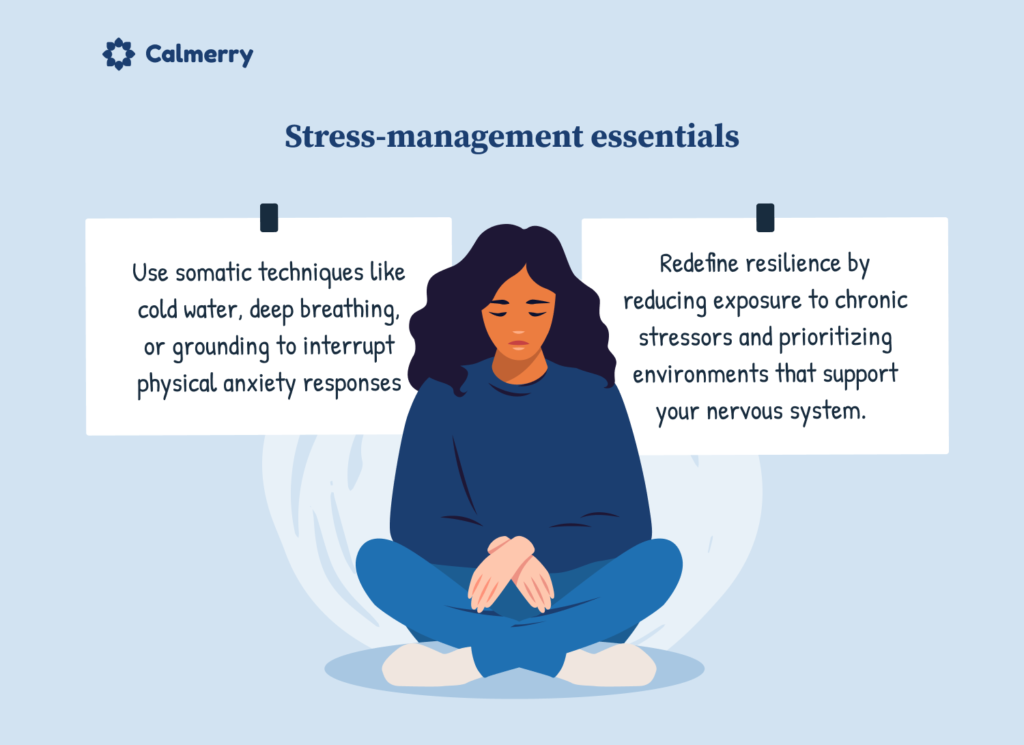
You cannot think your way out of a physical problem. When you experience anxiety, use your body to signal safety. Splash cold water on your face. Use deep breathing to stimulate the vagus nerve. These are biological overrides of the nervous system’s physical reactions.
Redefining Resilience to Reduce Effects on the Body
Life events and causes of anxiety are often external. If your job demands 24/7 availability, your body is paying the rent. Health information is useless if we don’t use it in practice. Admitting that your environment is affecting how you feel is the first step toward building a life that fits you, rather than one you have to survive. Detaching self-worth from endurance is crucial.
Treating Anxiety with Digital Tools
Here is where we flip the script. Historically, treating anxiety was ironically stressful, fighting traffic, sitting in sterile waiting rooms, and the awkwardness of a strange office. When your nervous system is already red-lining, the logistics of traditional counseling, the commute, the parking, the waiting room, can feel less like help and more like walking into a burning building.
Online anxiety intervention doesn’t just move therapy to a screen; it changes the texture of the healing process. It lets you open up from the safety of your own fortress.
Breaking Barriers with Online Therapy for Anxiety Symptoms
Online therapy for anxiety symptoms removes the performative aspect of being a patient. You can speak to a therapist from your bedroom. This safety lowers the cortisol baseline, making the therapy itself more effective.
Whether you are dealing with social anxiety disorder, panic attacks, or just a generalized type of anxiety disorder, platforms like Calmerry connect you with licensed professionals. A significant portion of the population will have an anxiety disorder at some point in their lives.
Virtual Anxiety Treatment for Panic Attacks and Maintenance
Virtual anxiety treatment often allows for flexible messaging. Anxiety and panic attacks don’t stick to a 9-to-5 schedule. Having online help for anxiety means you can reach out when the symptoms of a panic attack are rising, not 3 days later when the storm has passed.
Since many people also have an anxiety disorder alongside depression, digital therapy for anxiety offers a comprehensive approach. Therapists can help you untangle how mental health disorders are feeding into your physical and mental health.
Addressing Anxiety On The Body Today
The heavy metal drum solo in your chest does not have to be the soundtrack of your life forever.
We often wait for a “medical” illness to validate our pain. We wait for the doctor to find an actual physical cause, so we have permission to stop running. But you don’t need permission. The fact that you are hurting is enough. Anxiety symptoms are valid warnings.
If you are prone to panic attacks or feel that stress and anxiety are eating away at your vitality, taking action is an act of self-preservation. Anxiety physical harm prevention begins with a choice. It is the choice to stop treating your body like an adversary to be conquered and start treating it like a partner to be protected.
Current health topics often focus on diet and exercise, but the side of anxiety that impacts our longevity cannot be ignored. It seeps into all parts of your life. Anxiety can cause significant distress, but it is highly treatable.
You have options. You can utilize virtual anxiety treatment to decode the signals your body is sending throughout the body. You can set boundaries that protect your peace. You can start online therapy for anxiety symptoms today, right from where you are sitting.
The only wrong move is standing still in the fire, hoping the heat will eventually stop burning. Your body is asking for a truce. Isn’t it time you gave it one?
Chronic stress puts your health at risk. (n.d.). Mayo Clinic. https://www.mayoclinic.org/healthy-lifestyle/stress-management/in-depth/stress/art-20046037

online therapy
live video session