Postpartum Anxiety Symptoms


In this article
We are sold a very specific image of motherhood. Soft lighting. Pastel nurseries. A sleeping baby on a chest while mom gazes down, perfectly content.
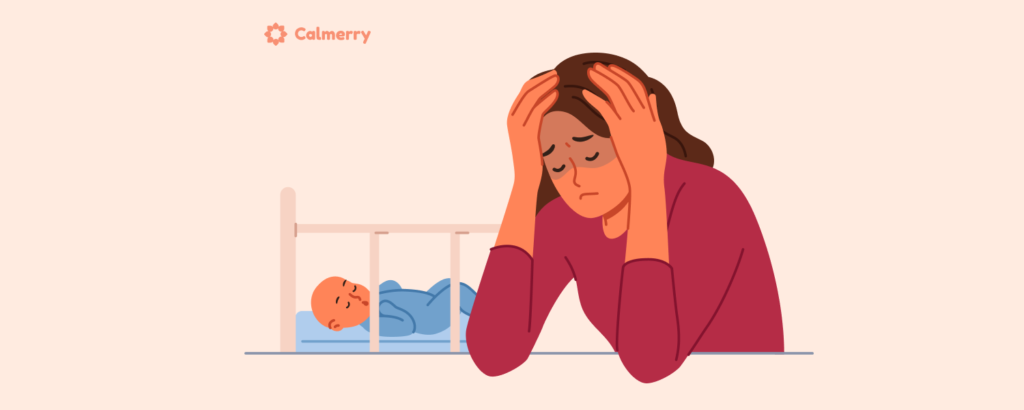
But for millions of women? The reality feels less like a lullaby and more like a fire alarm that won’t stop ringing.
When we talk about the “baby blues,” we usually picture sadness. But what if your struggle isn’t sadness? What if it’s a heart that hammers against your ribs at 3 AM? What if it’s a brain that spins catastrophic scenarios every time you close your eyes?
If you feel like you are “failing” because you aren’t enjoying every second, or if you are terrified that something terrible is about to happen, you aren’t broken. You are likely dealing with anxiety after childbirth.
This article breaks down the specific symptoms, the difference between postpartum anxiety and depression, and the maternal mental health strategies that can help you find your footing again.
What is Postpartum Anxiety?
Let’s get specific about what we’re actually talking about here.
Postpartum anxiety is a mental health condition characterized by intense, persistent worry or fear following childbirth. It isn’t just “worrying” in the normal sense. It is a worry that has grown teeth. It disrupts your daily functioning, making it hard to eat, sleep, or even sit still.
When these symptoms become severe, prolonged, and interfere significantly with a mother’s life or her ability to bond with her baby, it may be diagnosed as postpartum anxiety disorder.
It fits under the umbrella of perinatal anxiety, which encompasses anxiety during pregnancy and the postpartum period. This distinction matters because mother anxiety is often dismissed by well-meaning friends as “normal parent stress.” However, women with postpartum anxiety know that the internal volume is turned up much higher than normal.
Anxiety usually manifests as a feeling of impending doom. Normal stress is checking the car seat straps once. Postpartum anxiety is checking them five times, driving a mile, pulling over, and checking them again. While baby blues or postpartum depression are widely discussed, anxiety is the silent engine that drives many postpartum women to exhaustion.
Key Postpartum Anxiety Symptoms
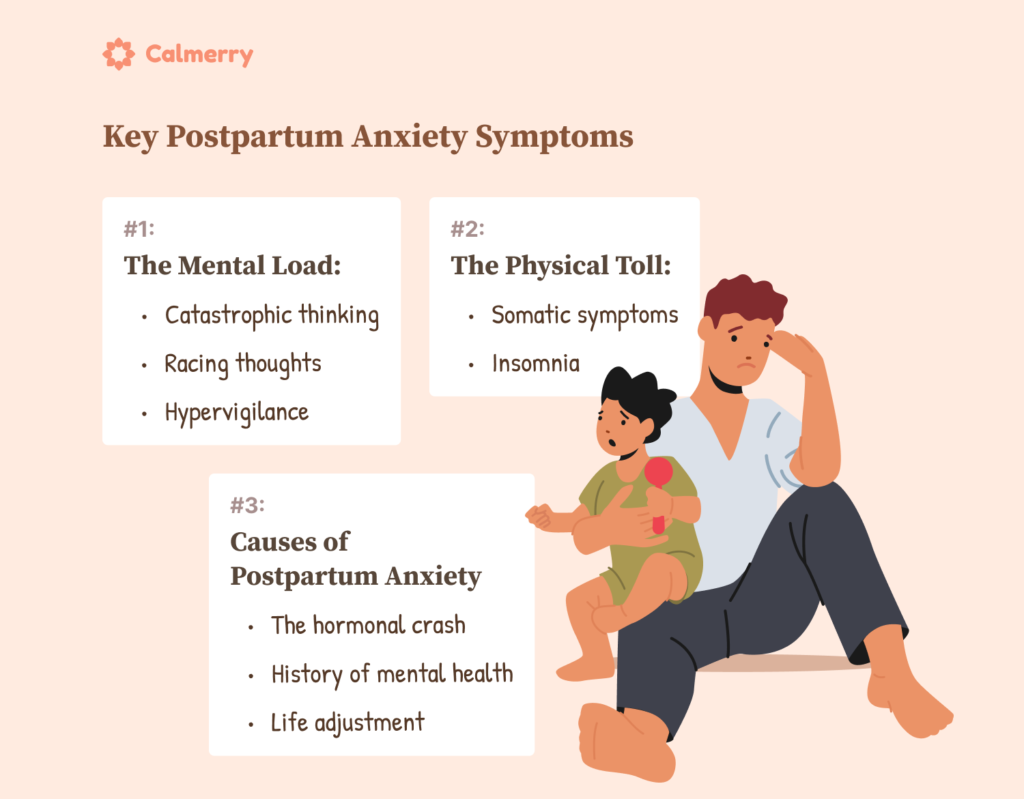
How do you know if you’ve crossed the line from “concerned parent” to clinical anxiety? Symptoms of postpartum anxiety often manifest physically before they do mentally. Your body might be sounding the alarm even if your brain is trying to rationalize it. Postpartum anxiety symptoms may vary from person to person, but they generally fall into specific categories.
Anxiety symptoms in new moms can include:
The Mental Load
- Catastrophic thinking: Your brain plays movies of the worst-case scenarios. You imagine dropping the baby, the baby suffocating, or a car accident, in vivid, terrifying detail.
- Racing thoughts: Your mind feels like a browser with 100 tabs open, and you can’t close any of them.
- Hypervigilance: You are on guard 24/7. You can’t sleep when the baby sleeps because you are listening for their breath. Postpartum symptoms like this are exhausting.
The Physical Toll
- Somatic symptoms: Physical symptoms are a hallmark of this condition. Heart palpitations, shortness of breath, trembling, dizziness, or nausea are common.
- Insomnia: You are exhausted, but the second your head hits the pillow, your body jolts awake. This is distinct from sleep deprivation caused by the baby; this is your body refusing to power down.
Postpartum stress can make you tired, but anxiety makes you vibrate. Women with postpartum issues often describe it as an electric current running under their skin. Whether you experience mild to moderate anxiety or severe anxiety, the impact is real.
Research published in the Journal of Affective Disorders notes that postpartum anxiety symptoms are distinct from general stress because of this high level of physical arousal. [1] Weiss, S. J., & Xu, L. (2024). Postpartum symptoms of anxiety, depression and stress: differential relationships to women’s cortisol profiles. Archives of Women S Mental Health, 27(3), 435–445. https://doi.org/10.1007/s00737-024-01421-9
The Spectrum: OCD, Generalized Anxiety, and More
It is important to realize that maternal anxiety isn’t one-size-fits-all. It exists on a spectrum of mood and anxiety disorders.
Generalized Anxiety vs. Postpartum Anxiety
Some women may have had generalized anxiety disorder (GAD) before pregnancy, while others develop generalized anxiety specifically after birth. Generalized anxiety involves broad, floating worry about everything, such as finances, health, and the house, whereas postpartum anxiety often hyper-focuses on the baby.
Postpartum OCD
A related but distinct condition is postpartum OCD. This involves intrusive, unwanted thoughts (obsessions) and repetitive behaviors (compulsions) to neutralize the fear. For example, a mother might have a terrifying, intrusive thought about the baby falling and then feel compelled to count the stairs repeatedly to “prevent” it. This is different from standard anxiety and depression, but it falls under the same umbrella of postpartum mental health.
Postpartum Depression vs. Anxiety: Knowing the Difference
We often conflate these two, but the battle of postpartum depression vs anxiety is a crucial distinction to make, even though many women experience postpartum issues that involve both.
Postpartum depression (often called postnatal depression or perinatal depression) is primarily a condition of depletion. It involves persistent sadness, low energy, feelings of worthlessness, and depressive symptoms. It feels like a heavy, wet blanket has been thrown over your life.
Postpartum anxiety, by contrast, is a condition of activation. It is driven by fear and anxiety rather than despair. You care too much, worry too much, feel too much.
The Co-Occurrence
Here is the tricky part: postpartum depression and anxiety frequently hold hands. The National Institute of Mental Health explains that depression and anxiety often coexist. [2] Perinatal depression. (n.d.). National Institute of Mental Health (NIMH). https://www.nimh.nih.gov/health/publications/perinatal-depression In fact, postnatal depression and anxiety overlap in symptoms like irritability and sleep issues.
A woman experiencing postpartum depression might feel numb, thinking, “I can’t do this.” A woman with anxiety might feel panic, thinking, “Something is wrong.” But if you have postpartum depression and postpartum anxiety together, you might feel an exhausting cycle of being wired (anxious) and then crashing (depressed).
It is also possible to have major depression with anxious distress. The lines between depression and anxiety can blur, which is why professional diagnosis is key.
Diagnosis: How Do We Know?
Because symptoms of depression and symptoms of anxiety overlap, specialists use specific tools. The Edinburgh Postnatal Depression Scale is commonly used to screen for postpartum depression experience, but it also includes questions that can flag significant anxiety symptoms.
Therapists look at the severity. Mild to moderate postpartum anxiety might be managed with support, while moderate to severe anxiety usually requires clinical intervention. Whether you are in the early postpartum days or several months postpartum, these screenings save lives.
Causes of Postpartum Anxiety
Why is this happening? It is not because you are weak. What causes postpartum anxiety is a perfect storm of biology and circumstance.
- The hormonal crash: Rapid drops in estrogen and progesterone can disrupt brain chemistry.
- Sleep deprivation: Disrupted sleep heightens postpartum stress.
- History of mental health: A history of depression or a previous diagnosis of generalized anxiety increases your risk of depression and anxiety after birth.
- Life adjustment: The sheer weight of responsibility can trigger severe postpartum worry.
A 2018 study in Archives of Women’s Mental Health confirms that this cocktail creates a biological susceptibility. [3] Chen, Y., Yang, H., Sheng, B., Zhou, L., Li, D., Zhang, M., & Wang, Y. (2024). Consumption of sugary beverages, genetic predisposition and the risk of depression: a prospective cohort study. General Psychiatry, 37(4), e101446. https://doi.org/10.1136/gpsych-2023-101446 Women with postpartum depression or anxiety are reacting to physiological shifts.
Impact on New Mothers
- The toll of postpartum anxiety extends far beyond the internal experience. It bleeds into every corner of your life.
- Difficulty bonding: It is hard to snuggle when your body is rigid. You might be so focused on safety that you struggle to just be.
- The shame spiral: Many mothers feel guilt. They think, “I should be happy,” which fuels the depression and anxiety.
- Functioning: Significant anxiety symptoms can make it hard to leave the house or trust others with the baby.
The Mayo Clinic warns that untreated maternal mental health issues can lead to chronic mood and anxiety disorders. [4] Postpartum depression – Symptoms and causes. (n.d.). Mayo Clinic. https://www.mayoclinic.org/diseases-conditions/postpartum-depression/symptoms-causes/syc-20376617
Recognizing When to Seek Help
You should seek professional help if you experience symptoms of postpartum distress that:
- Persist beyond two weeks.
- Intensify rather than improve.
- Interfere with your ability to care for yourself or the baby.
Here are some red flags to consider:
- Frequent panic attacks.
- Inability to sleep even when the baby is sleeping.
- Intrusive thoughts.
- Feelings of anxiety that turn into hopelessness.
If you suffer from postpartum distress, early intervention is vital to prevent postpartum anxiety disorder from becoming chronic.
Postpartum Anxiety Treatment Options
You do not have to white-knuckle this. Treatments for postpartum conditions are effective.
1. Cognitive-Behavioral Therapy (CBT)
Cognitive behavioral therapy is the gold standard. It helps you identify catastrophic thoughts and reframe them. It is highly effective for women who experience postpartum anxiety.
2. Medication
Many women with postpartum issues benefit from medication. SSRIs are commonly used for the treatment of depression and anxiety and are often compatible with breastfeeding. Treatment for postpartum depression and anxiety often involves this pharmacological support.
3. Accessible Support
You don’t have to leave your house to get help. Platforms like Calmerry offer online counseling, which is a game-changer for postpartum women who can’t commute.
4. Self-Care
To manage anxiety, simple steps like prioritizing sleep (where possible) and reducing caffeine help. However, for severe anxiety, self-care is a supplement to, not a replacement for, professional care.
Postpartum Anxiety Does Not Define Motherhood
The narrative of the “blissful new mom” is dangerous because it leaves no room for the reality of postpartum anxiety symptoms.
If your heart is racing, if your mind is flooded with symptoms of postpartum anxiety, know this: It is not a reflection of your ability to mother.
Whether it is postpartum depression or anxiety, generalized anxiety, or postpartum OCD, these are medical conditions. From the postpartum anxiety causes rooted in biology to the postpartum anxiety treatment options available, the path to healing is well-trodden.
You can love your baby and still need help. Don’t wait for the storm to pass on its own. Whether you are weeks postpartum or months into the journey, reach out. By addressing anxiety after childbirth, you aren’t just helping yourself—you are building a safer, calmer world for your child.
Weiss, S. J., & Xu, L. (2024). Postpartum symptoms of anxiety, depression and stress: differential relationships to women’s cortisol profiles. Archives of Women S Mental Health, 27(3), 435–445. https://doi.org/10.1007/s00737-024-01421-9
Perinatal depression. (n.d.). National Institute of Mental Health (NIMH). https://www.nimh.nih.gov/health/publications/perinatal-depression
Chen, Y., Yang, H., Sheng, B., Zhou, L., Li, D., Zhang, M., & Wang, Y. (2024). Consumption of sugary beverages, genetic predisposition and the risk of depression: a prospective cohort study. General Psychiatry, 37(4), e101446. https://doi.org/10.1136/gpsych-2023-101446
Postpartum depression – Symptoms and causes. (n.d.). Mayo Clinic. https://www.mayoclinic.org/diseases-conditions/postpartum-depression/symptoms-causes/syc-20376617

online therapy
live video session