Why Does My Anxiety Impact My Social Circles


In this article
Sarah observed that whenever she joined the group chat, the conversation would come to a halt. Her friends seemed to be planning things without her. She felt that her worrying and cancellation habits were pushing her friends away.
What about you? Ever wondered if anxiety’s affecting friendships and the impact on your social life is all in your head? Well, the answer is that anxiety’s impact on your social life is real, and it’s not all in your head.
A study found that individuals experiencing higher social anxiety exhibited lower friendship quality and strained interactions. It’s a documented pattern that impacts nearly 12 million adults in their social relationships. This proves that anxiety’s impact isn’t limited to discomfort. [1] Rodebaugh, T. L., Lim, M. H., Shumaker, E. A., Levinson, C. A., & Thompson, T. (2015). Social Anxiety and Friendship Quality over Time. Cognitive Behaviour Therapy, 44(6), 502–511. https://doi.org/10.1080/16506073.2015.1062043
Anxiety’s impact on your social life isn’t about you as an individual. It’s not about your personality or your worth. It’s about how stress affects your life, including your circle, family, romantic life, work, and community.
This article will help you decode the impact of social anxiety on your daily life. It will also provide you with some useful tips and contemporary therapy to help you overcome anxiety’s impact on your life.
The Hidden Ways Anxiety Reshapes Your Social Dynamics
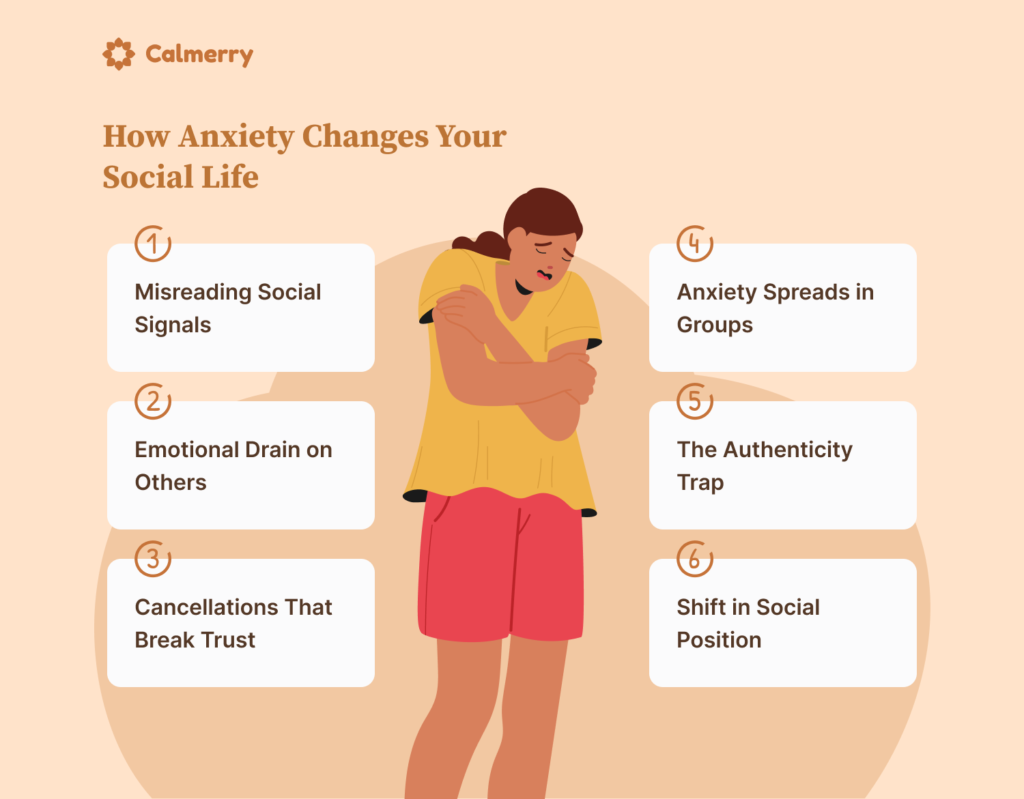
Worry’s lasting impact on social interactions is seen in the ways it changes social calibration. When worry is at the forefront, even a neutral facial response or a pause in conversation may be perceived as judgment, leading to defensive or awkward social interactions that do not flow as smoothly as they would otherwise.
Anxiety and social relationships may also surface as a result of emotional dependency. This is where the person with stress may rely too heavily on the people around them to manage their emotions and provide reassurance, making the people around them feel responsible for the person’s emotional well-being.
Additionally, constant canceling of plans may create a rift between the person and the people around them. People may start to feel as though the person with anxiety is not reliable and does not want to spend time with them.
Finally, social anxiety’s impact on interactions is seen in the way emotional strain spreads between people. This is where the anxiety of the stressed person is felt by the people around them. This may manifest as emotional contagion, in which the group’s overall emotional state is influenced by the worry of the anxious person.
This may also mean that the people around the person under stress develop anxiety themselves, as they worry about the person’s comfort and adjust the social activity to avoid making the person with worry uncomfortable.
Finally, the impact of emotional strain on social interactions is seen in the ways it changes the social roles of the people involved. For instance, the loss of assertiveness may mean that the person with anxiety is passed over for promotions and leadership roles and eventually finds themselves socially isolated.
Immediate Intervention Strategies: Stopping the Social Spiral
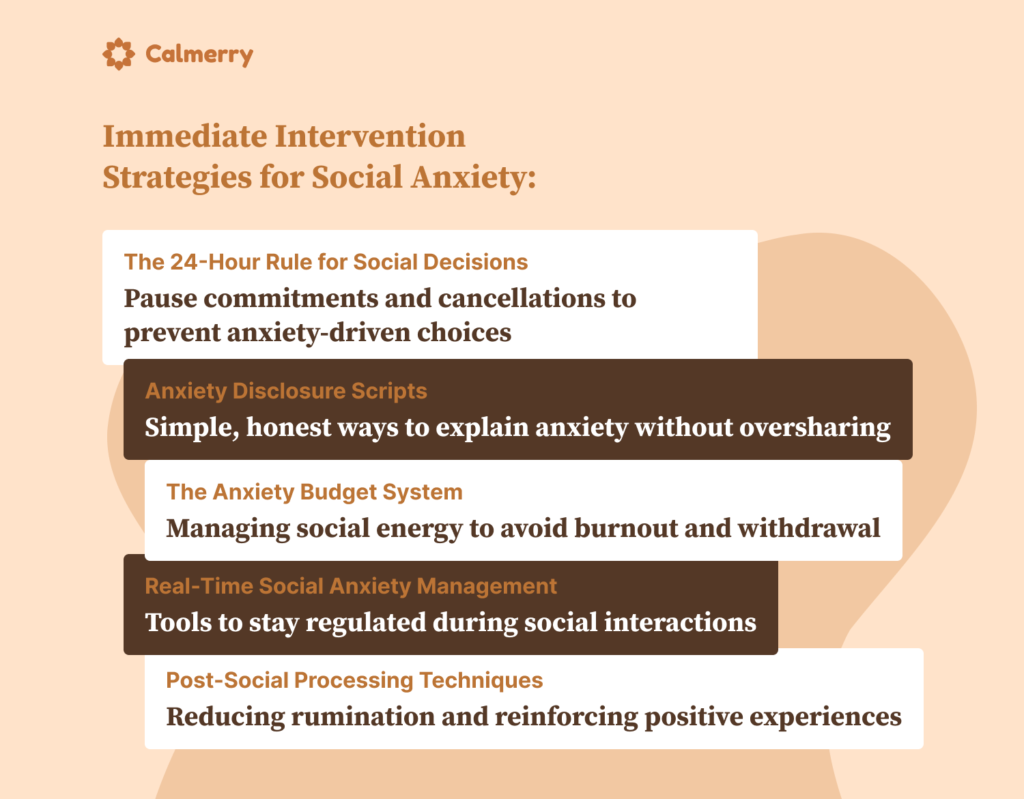
Anxiety has the ability to damage relationships rapidly, but social anxiety coping strategies help to prevent further damage while underlying issues are addressed. These coping mechanisms can help you to manage social anxiety:
- The 24-hour rule to guide social decisions: This involves avoiding any decisions or cancellations when worry is high. Using filler comments like, “Let me check and get back to you tomorrow,” and then re-evaluating the situation when anxiety has passed to avoid linking nervousness to preference.
- Straightforward anxiety disclosure: This involves disclosing worry to avoid linking withdrawal to other people. Using comments like, “I am dealing with anxiety right now, it’s not about you,” to avoid disclosing stress to other people.
- Anxiety budget to prevent relationship burnout: This involves assigning costs to worry and then communicating these costs to other people to avoid cancellations that might be perceived as intentional.
- Anxiety coping mechanisms during social interactions: This involves stepping away to cope with worry, using pre-prepared questions to cope with stress, and making one genuine comment to cope with anxiety.
- Anxiety coping mechanisms after social interactions: This involves writing down positive interactions, analyzing interactions, and sending a follow-up message to cope with stress.
Rebuilding Your Social Circle: Long-Term Relationship Recovery
Rebuilding your social connections after anxiety has strained them is definitely possible, but it does require structure and patience. To rebuild social connections, one must start with gradual engagement. This means starting with low-level relationships or activity-based interactions, gradually building up to more complex engagements as one gains more confidence.
For progress with anxiety in social relationships, consistency is key. Scheduled social engagements can reduce feelings of pressure when trying to engage with others and are more effective than maintaining a multitude of relationships. Engaging in physical activities, such as walking, cooking, or a hobby, is also easier than having deep, emotionally charged conversations.
Making “anxiety allies” within one’s social circle is also beneficial, as having 1 or 2 people who understand one’s worry and are willing to work with it to provide grounding support and help one work through difficult conversations is very helpful. Having boundaries, such as setting a specific end time or engaging in a less intense environment, also helps prevent feelings of resentment on both sides.
Confidence, as with social relationships, also improves with repetition. This means engaging in brief daily interactions, gradually building up to weekly scheduled social engagements, and finally engaging in initiating conversations and being vulnerable with others.
If one’s anxiety has strained their relationships, it is also important to acknowledge this, as this improves relationship quality. Engaging in structured social skills training to gradually improve social functioning can also help.
When Your Social Anxiety Requires Professional Support
However, when social anxiety starts to control your life as opposed to merely affecting it, professional assistance is required. Seeking professional help in the form of anxiety therapy is recommended when you have avoided social situations for several months, have lost important relationships, have severe physical symptoms when in social situations, or when anxiety interferes with work, school, or other daily responsibilities.
When you use alcohol or drugs to cope with social situations, or when you have become so withdrawn that you are almost in complete isolation, it is time to consider professional assistance beyond self-help techniques.
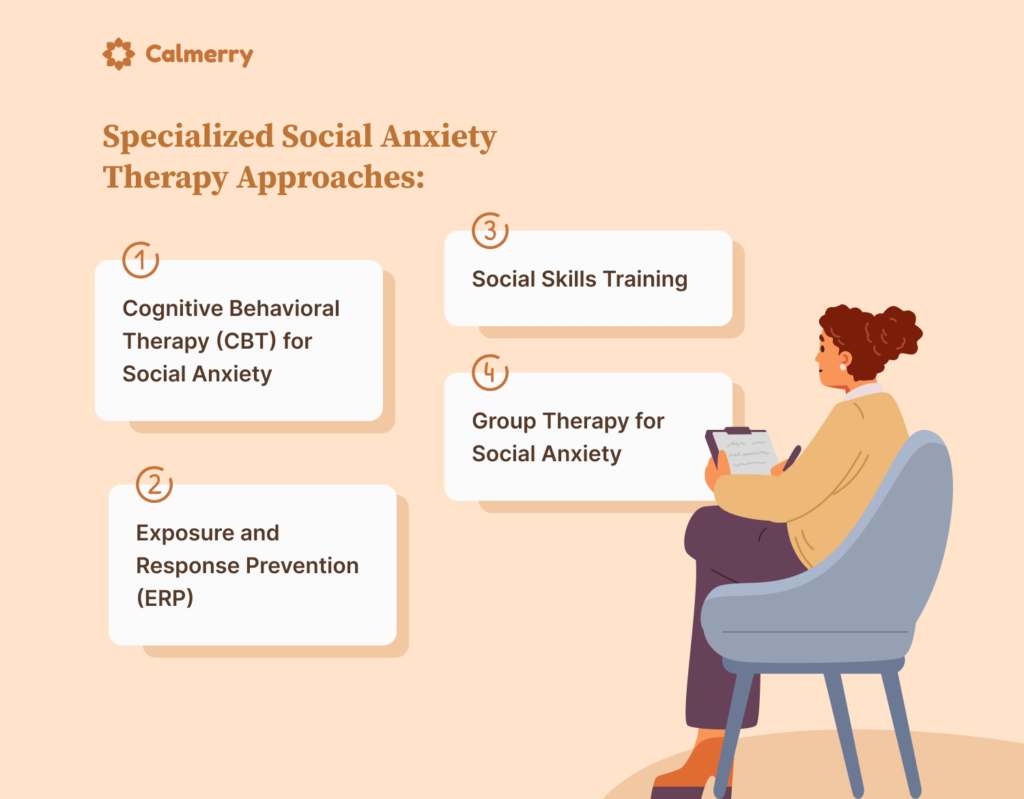
Professional help for anxiety is not merely talking about one’s problems. Cognitive Behavioral Therapy (CBT) is the most effective therapy for social anxiety disorder. CBT is a therapy that challenges negative thought patterns about social situations through behavioral experiments.
Exposure therapy is another form of therapy that gradually exposes you to situations that you have been avoiding. In fact, there are 70-80% improvement in social functioning with structured therapy. [2] Barlati, S., Nibbio, G., & Vita, A. (2024). Evidence-based psychosocial interventions in schizophrenia: a critical review. Current Opinion in Psychiatry, 37(3), 131–139. https://doi.org/10.1097/yco.0000000000000925
Social skills therapy is useful in building your self-confidence in dealing with people. Group therapy is another form of therapy that provides an environment to interact with other people who have similar problems.
In seeking professional assistance, the initial step is to assess your triggers and avoidance patterns. The second step is skill building and exposure, followed by the final step that prevents any relapse.
Structured therapy is effective in helping individuals overcome their social anxiety disorder. Seeking professional assistance, such as Calmerry, is not an admission of failure; it is an acknowledgment that you want to overcome your anxiety disorder to improve your life.
Calmerry’s Online Therapy: Specialized Treatment for Social Anxiety
Calmerry provides a streamlined and stress-free route to online social anxiety therapy that is geared towards individuals who have experienced social anxiety-related problems in their friendships and lives.
As an online therapy platform, Calmerry provides access to experienced therapists knowledgeable in anxiety, relationships, and social skills. This is particularly important as traditional therapy services are often intimidating for many individuals.
One of the key benefits of using Calmerry for social anxiety therapy is the absence of stress when undergoing therapy. This is particularly important for individuals who experience social worry. There are no waiting rooms and no need for face-to-face therapy sessions.
This allows individuals to seek professional help for anxiety as soon as possible rather than waiting and allowing stress to build up. This is particularly important as individuals are often reluctant to seek therapy, as they may feel embarrassed about having anxiety.
Another important benefit of using Calmerry for social anxiety therapy is the flexibility of the service. This allows individuals to seek professional help for nervousness from any location.
Your Social Circle Is Worth Fighting For
Anxiety in friendships is a very personal thing, and yet it is also something that is very treatable. The behaviors that are causing problems in your friendship, such as withdrawal, overthinking, cancellation of plans, and emotional strain, are all predictable and treatable results of anxiety and not a fundamental problem with who you are as a person.
The first thing to understand is that anxiety impacts and changes relationships in very specific and measurable ways, and it does not change or eliminate a person’s ability to connect with others. There are many things you can do right now to stop further damage to your relationships, and techniques for rebuilding social connections can help heal and strengthen them over time.
For those who are struggling with more serious levels of anxiety, anxiety treatment is available to help you overcome this.
Your level of social confidence is not something that you are born with or without; it is a skill set, and like any skill set, it is something that can be developed and strengthened over time with support and practice. It may take some time to rebuild a circle, and many people see significant and meaningful change in 6 to 12 months, but it is well worth it to see a more confident and connected person.
While anxiety may have certainly changed and impacted your various social circles, it does not define who you are and what you are capable of in terms of meaningful relationships, and every single relationship in your life, including those that are yet to come, benefits from your decision to heal and get better.
Rodebaugh, T. L., Lim, M. H., Shumaker, E. A., Levinson, C. A., & Thompson, T. (2015). Social Anxiety and Friendship Quality over Time. Cognitive Behaviour Therapy, 44(6), 502–511. https://doi.org/10.1080/16506073.2015.1062043
Barlati, S., Nibbio, G., & Vita, A. (2024). Evidence-based psychosocial interventions in schizophrenia: a critical review. Current Opinion in Psychiatry, 37(3), 131–139. https://doi.org/10.1097/yco.0000000000000925

online therapy
live video session