Understanding Unspecified Anxiety Disorder: Online Help That Works



In this article
The Myth of the Perfect Label
There is a peculiar, deeply human paradox at play in modern healthcare. We tend to assume that naming a problem is halfway to solving it. We crave the Latin precision of a diagnosis. We want the comfort of a solid, immutable label. We want to be told we have “generalized anxiety disorder” or “panic disorder” because those terms feel like known quantities. They feel like boxes that come with a matching set of keys.
So, when you walk out of a clinician’s office clutching a summary that reads “unspecified anxiety disorder,” the reaction is almost always a cocktail of confusion and disappointment.
It feels like a letdown. It feels like a linguistic shrug. You might find yourself wondering if your suffering was too vague to register on the medical Richter scale, or if the doctor simply didn’t care enough to flip to the right page in the textbook. You wanted a roadmap, and you got a sticky note that says “lost.”
But we need to challenge that narrative. We need to dismantle the idea that a specific diagnosis is the only valid one.
The desire for a tidy category is natural, but it is often misguided. The human mind is not a spreadsheet. It does not adhere to the rigid rows and columns of the DSM-5-TR. [1] DSM. (n.d.). https://www.psychiatry.org/psychiatrists/practice/dsm When a doctor gives you an “unspecified” diagnosis, they are not failing to categorize you.
They are doing something far more radical and honest. They are refusing to force your unique, chaotic, complex experience into a pre-fabricated box that doesn’t fit.
Think of the standard diagnoses as off-the-rack suits. They fit “most” people “mostly” well. But about 15 to 20 % of people seeking anxiety treatment don’t fit the standard measurements.
Their anxiety is bespoke. By using the “unspecified” label, your clinician is prioritizing clinical honesty over a comforting, yet inaccurate, categorization. They are acknowledging that your mental landscape is unique, and that is actually a good thing.
The “Fast Pass” Theory
We often assume that the rigorous criteria of standard diagnoses exist to protect us. We think they ensure quality control. In reality, however, the strict rules for standard anxiety disorders can sometimes act as a barrier to getting the help you actually need.
Consider the clinical requirements for generalized anxiety disorder (GAD), the most common “standard” label. To officially qualify for this badge, you typically need to experience excessive, uncontrollable anxiety more days than not for a period of at least 6 months.
But pause for a moment and consider the implications of that rule. What if you are in month 3?
What if your anxiety is crushing right now? What if it keeps you awake every single night, ruins your appetite, and makes it impossible to focus on your work? If we strictly interpret the rulebook, you don’t have GAD yet. You are in a diagnostic limbo. You are suffering, but you haven’t suffered long enough to earn the title.
This is where the “unspecified” diagnosis transforms from a vague placeholder into a strategic advantage. It acts as a medical “fast pass.”
By using this label, a clinician can bypass the bureaucratic red tape associated with time requirements. It acknowledges that suffering is happening in the present tense. It tells insurance companies and treatment providers that intervention is necessary immediately, regardless of how many days you have been marking off on the calendar.
There is also a persistent, pernicious myth that we need to squash: the idea that “unspecified” equals “mild.” This is dangerous thinking. Specificity refers to the pattern of symptoms, not the volume of the pain. A person with a very specific phobia of snakes might live a perfectly happy life as long as they avoid the reptile house at the zoo.
Meanwhile, a person with unspecified anxiety might be unable to leave their home because of a complex, shifting wall of panic. The label validates the severity of the distress without demanding a six-month waiting period to prove it.
The Hybrid Mind
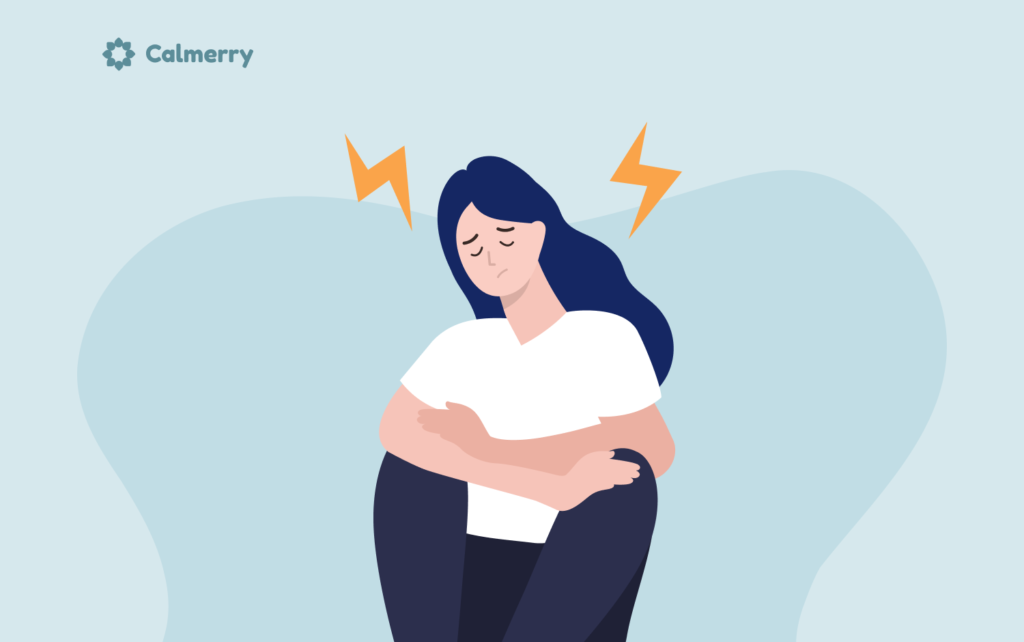
The other significant drawback with our obsession with standard diagnoses is that they treat mental health symptoms as if they are distinct islands. The medical model suggests you either worry about everything (GAD), or you worry about social judgment (social anxiety), or you panic (panic disorder). It implies these are separate circuits in the brain.
But for that significant minority of clients, the 15 to 20 % we mentioned, anxiety is rarely that tidy. It is a hybrid.
You might possess a mind that operates like a kaleidoscope. You might experience the intense, chest-tightening performance fears typical of social anxiety, but only when you are speaking to authority figures, never at parties.
At the same time, you might experience sudden panic attacks, but they aren’t random; they are triggered by very specific stressors, which disqualifies you from a classic panic disorder diagnosis.
If a doctor were to force a specific label on you, they would likely miss half the picture. If they label you with social anxiety, they might ignore the panic elements. If they label you with panic disorder, they might ignore the social triggers.
The “unspecified” diagnosis respects the hybrid nature of your mind. It acknowledges that you are dealing with a complex constellation of symptoms that don’t map perfectly to the textbook.
And let’s not forget the somatic reality. Your body does not care what code is written on your chart. The physiology of fear is ancient and precise. You know the sensation. It is the heart beating against your ribs while you are resting on a sofa. It is the palm perspiration in a frigid room.
It is the phantom constriction of the thorax that sends people to the emergency room convinced they are dying, only to be told their heart is fine.
These physical symptoms are real. They are debilitating, and they happen regardless of whether your anxiety fits a specific definition. The “unspecified” label accepts this physical reality without requiring it to align with a checklist designed in a conference room decades ago.
Protocol vs. Person
In conventional medicine, protocols are king. We love protocols because they are efficient. If you have strep throat, you take Amoxicillin. If you have a broken tibia, you get a cast. It is a linear equation.
Mental health attempts to mimic this efficiency, but it often fails when applied to complex human beings. If you are diagnosed with textbook GAD, a therapist might pull out the “GAD Workbook,” open it to page one, and start the standard procedure. It is efficient, sure. But is it effective?
If your anxiety doesn’t look like the example on page one of the workbook, that rigid protocol becomes a hindrance. You might spend weeks working on skills that don’t actually address your specific struggle because the therapist is treating the diagnosis, not the person.
Unspecified anxiety forces a disruption of this assembly-line approach. Because there is no standard “Unspecified Anxiety Workbook,” the therapist cannot rely on a pre-scripted plan. They are forced to look at you.
This diagnosis demands a customized approach. It shifts the focus from rigid protocols to evidence-based principles that are tailored to your specific cognitive architecture.
Cognitive Behavioral Therapy (CBT) remains the cornerstone of treatment, but in this context, we apply it in a different way. Instead of following a rigid manual, we use CBT as a set of flexible tools. We act like hackers looking at your specific code.
We identify the specific “cognitive distortions”, the lies your brain tells you, that are fueling your distress. Maybe your distortion is “catastrophizing” about health. Maybe it is “mind-reading” what your boss thinks of you. We target those specific glitches, regardless of their category. Learn more about how cognitive behavioral therapy works.
Acceptance and Commitment Therapy (ACT) is arguably even more relevant for the unspecified patient. Since this type of anxiety is often unpredictable, spiking one day, dormant the next, ACT teaches a vital skill: navigating uncertainty.
Conventional treatment often promises symptom reduction. ACT offers something different: psychological flexibility. It teaches you to stop fighting the waves and start learning to surf. You acknowledge the anxiety as background noise, like a radio playing in the other room, while you continue to focus on living a life that aligns with your values.
The Environmental Shift

We spend a tremendous amount of energy debating what treatment people need, what modalities, what medications, what coping skills. But we rarely stop to question where that treatment should happen.
The status quo of mental health care is geographically rigid. The model has remained unchanged for a century: You identify a problem. You drive to an office. You find parking. You sit in a waiting room with other silent, struggling people. You enter a strange room. You talk for 50 minutes. You leave.
For someone dealing with anxiety, this environment is often counterproductive. The very friction of accessing care can exacerbate the condition we are trying to treat.
Think about the commute. The traffic. The fear of being late. The social exposure of the waiting room. By the time you sit down in the therapist’s chair, your cortisol levels may have already spiked. You might spend the first 20 minutes of your expensive session just trying to regulate your nervous system back to baseline.
This is where online therapy offers a compelling, often overlooked advantage. Studies suggest that virtual care is clinically effective, but they often miss the nuance of why it works so well for anxiety. [2] Abrams, Z. (n.d.). How well is telepsychology working? https://www.apa.org/monitor/2020/07/cover-telepsychology
It works because it gives you environmental control.
When you engage in therapy from your own space, the power dynamic shifts. You are on your turf. You are wrapped in your own blanket. You are drinking from your own mug. You are safe.
This safety is not just a luxury; it is a clinical accelerant. When defenses are lowered, you can access vulnerable thoughts and difficult emotions much faster than you would in a sterile, unfamiliar clinical setting.
For a condition like “unspecified anxiety,” which is often slippery, vague, and hard to pin down, being in an environment where you feel secure can help you articulate your experience with greater clarity.
Furthermore, anxiety does not operate on a weekly calendar. It does not wait for your Tuesday at 2 PM slot. It wakes you up at 3 AM on a Thursday. It hits you in the bathroom before a big presentation.
The traditional model asks you to hold onto that distress for a week until your next appointment. By then, the feeling has faded, and the opportunity to work through it is lost. Digital platforms challenge this by offering asynchronous messaging. It allows you to capture the spiral in real-time.
You can reach out when the iron is hot. This transforms therapy from a weekly event into a continuous thread of support.
How Calmerry Fits the Narrative
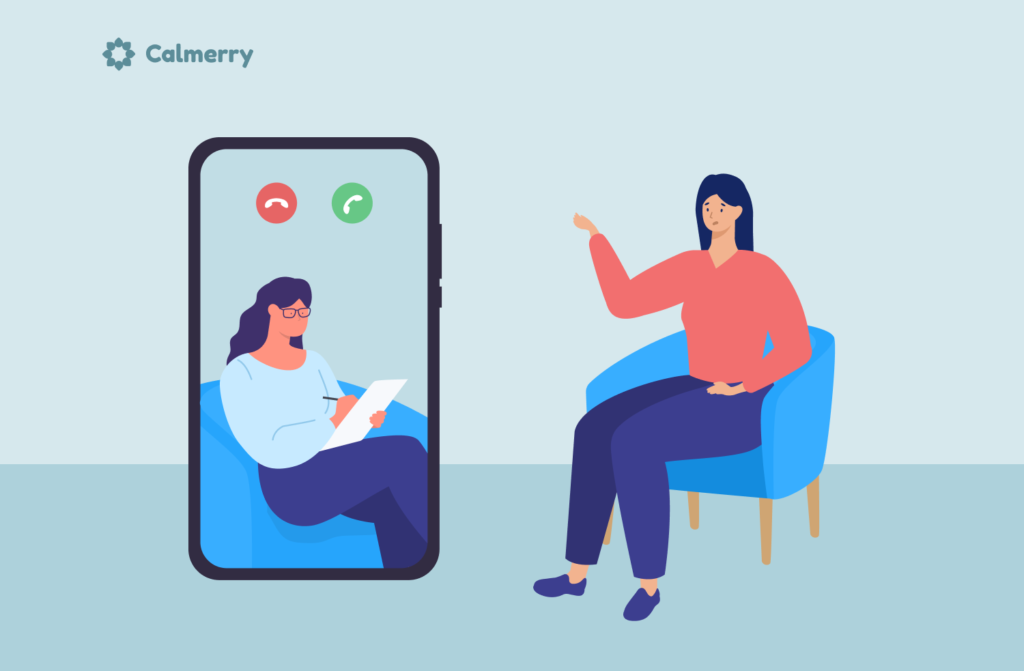
At Calmerry, we aren’t interested in force-fitting you into a diagnostic category just to make things easy for us. We understand that mental health is inherently messy, nonlinear, and complex.
We connect you with licensed professionals who are comfortable with ambiguity. These are therapists who understand that “unspecified” is not a lack of knowledge; it is an invitation to explore what is actually going on without preconceived notions.
We match you with providers who look past the label to see the human. Through flexible scheduling that acknowledges your busy life, and text-based support that acknowledges the unpredictability of your symptoms, we provide a space where your unique experience is the blueprint for your recovery.
You don’t need a perfect, textbook label to start feeling better. You just need a partner who is willing to listen to the whole story, however complex it might be. Recovery isn’t about fitting in a box; it’s about breaking out of the cage.
Abrams, Z. (n.d.). How well is telepsychology working? https://www.apa.org/monitor/2020/07/cover-telepsychology

online therapy
live video session