Top Employee Well-Being Programs for Companies in 2026



Table of Contents
Burnout is not a personal problem. It is an organizational signal. According to the American Psychological Association’s 2024 Work in America survey, 67% of workers reported experiencing at least one symptom of workplace burnout in the past month, including low energy, disengagement, and difficulty concentrating. The compounding effect on output, retention, and morale is measurable.
At the same time, only 31% of U.S. employees were engaged at work in 2024 — the lowest engagement rate in a decade. Disengaged employees are not necessarily bad employees. They are often people working in environments that do not support them well. That distinction matters because it means the problem is solvable.
Employee well-being programs give organizations a structured way to address these challenges. This guide covers what these programs are, how corporate employee well-being programs work across different company types, what the evidence says about their impact, and how to choose the right approach for your workforce.
What Are Employee Well-Being Programs?
Employee well-being programs are employer-sponsored initiatives designed to support the physical, mental, financial, and social health of the workforce. They go beyond standard benefits packages. Where a benefits package covers what employees are entitled to, a well-being program actively promotes and sustains health across multiple dimensions.
Core Components of Employee Well-Being Programs
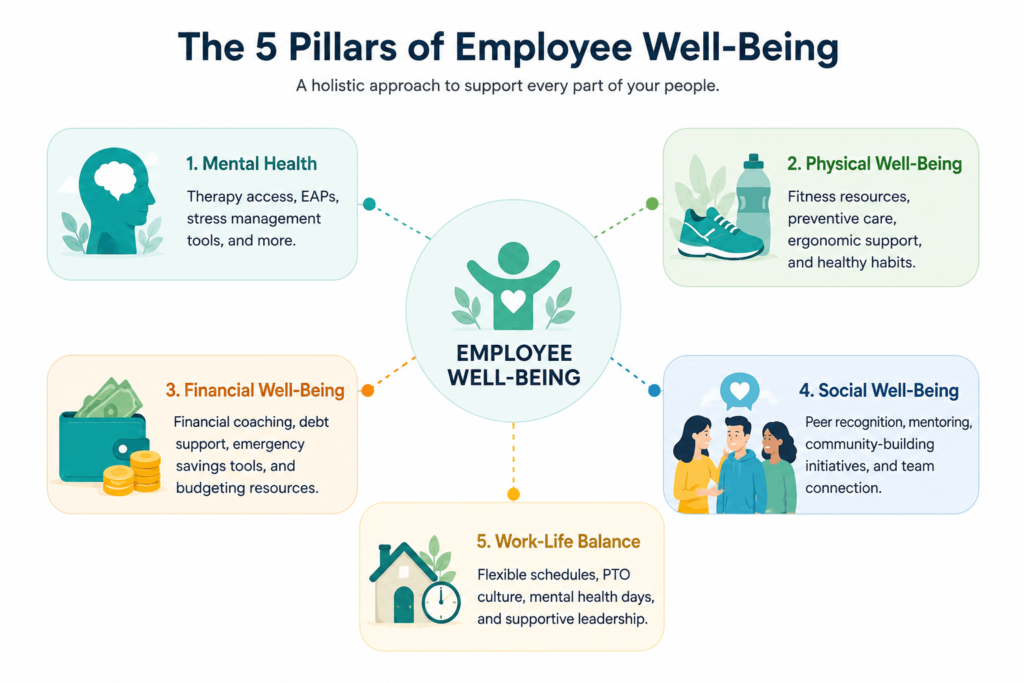
Mental health support
Includes: Therapy access, EAPs, and stress management tools
How it works: Employees access licensed support through employer-sponsored platforms or benefits.
Physical well-being
Includes: Fitness resources, preventive care, and ergonomic support
How it works: Through reimbursements, screenings, virtual classes, or wellness programs.
Financial well-being
Includes: Financial coaching, debt support, and emergency savings tools
How it works: Educational resources, payroll-linked tools, and coaching sessions.
Social well-being
Includes: Peer recognition, mentoring, and community-building initiatives
How it works: Team challenges, social groups, and recognition platforms.
Work-life balance
Includes: Flexible schedules, PTO culture, and mental health days
How it works: Through policy-level support reinforced by managers and leadership.
Programs can be delivered in person, digitally, or in a hybrid model. The most effective employee wellbeing programs are not one-off initiatives — they are ongoing, structured, and tied to measurable goals.
Why Employee Well-Being Programs Matter
The business case is clear and well-documented. Poor employee well-being generates costs that spread across HR, operations, and finance simultaneously.
High absenteeism
Companies with wellness programs report 14–19% lower absenteeism rates.
Healthcare cost growth
91% of HR leaders report lower healthcare benefit costs after implementing wellness initiatives.
Voluntary turnover
Organizations with wellness programs see 25% lower turnover compared to those without structured support.
Low engagement
Companies with employee well-being initiatives report a 67% increase in employee satisfaction and a 66% improvement in work efficiency.
Productivity loss
Employees with access to wellness programs are 40% less likely to feel stressed and significantly more likely to feel appreciated at work.
“Organizations that invest in employee well-being often see the benefits reflected in retention, engagement, and long-term performance.” | Employee well-being insight
Key Benefits
The benefits flow in both directions. Employees receive meaningful support. Organizations see measurable returns.
For employees
- Access to mental health support without stigma
- Better stress management tools
- Stronger work-life balance
- Financial guidance and support
- Improved social connection and belonging
For employers
- Reduced absenteeism
- Lower turnover and recruitment costs
- Improved productivity
- Stronger employer branding
- Lower healthcare and disability claims
As of 2024, 93% of employees consider well-being support as important as their salary. For employers, this means the well-being offering is increasingly a deciding factor in whether candidates accept offers and whether employees stay.
Types of Employee Well-Being Programs
Mental Health Programs
Mental health support is the fastest-growing category in corporate well-being. Mental health services are now offered by 86% of employers, with mental health mobile apps provided by 41%. These programs include EAPs, direct therapy access, manager mental health training, and digital tools for stress management, mindfulness, and emotional resilience. Platforms like Calmerry provide employees with access to licensed therapists through a structured, employer-sponsored model.
Physical Well-Being Programs
Physical programs extend well beyond gym memberships. Modern offerings include virtual fitness classes, step challenges, nutrition coaching, sleep support, ergonomic assessments for remote workers, and preventive health screenings. These initiatives address the physical dimension of well-being while generating measurable reductions in healthcare costs.
Financial Well-Being Programs
Dealing with debt is now the biggest financial stressor for employees at 68%, surpassing inflation concerns. Employee financial well-being programs respond to this by providing financial coaching, debt management guidance, emergency savings support, retirement planning resources, and budgeting tools. 77% of employers reported either offering or planning to offer emergency savings accounts within the next year or two.
Social Well-Being Initiatives
Loneliness and isolation are measurable productivity problems, particularly in hybrid and remote environments. Social well-being programs include peer recognition platforms, mentoring programs, team challenges, community groups, and structured social events. These initiatives build the connection that sustains engagement over time.
Work-Life Balance Programs
Flexible scheduling, remote work options, mental health days, and a culture that actively respects time off are all part of this category. Only 40% of employees report working in an environment where time off is genuinely respected. Policy changes in this area tend to have an outsized impact on burnout prevention because they address the structural causes of stress rather than just the symptoms.
Employee Wellbeing Programs Examples
Different organizations build well-being programs around their workforce size, culture, and most pressing challenges. The following examples reflect how a range of company types approach the problem.
- Large Enterprise — comprehensive mental health platforms that combine therapy, coaching, EAP access, and manager training tied to HR performance metrics.
Reported outcome: Higher utilization rates and measurable reductions in disability claims. - Mid-size Business — digital wellness platforms with step challenges, nutrition tools, and financial coaching webinars.
Reported outcome: Improved engagement scores and lower absenteeism. - Small Business — EAP access through existing healthcare plans combined with mental health days policies and manager training resources.
Reported outcome: Stronger team trust and reduced voluntary turnover. - Startup — mental health app subscriptions, flexible PTO policies, and founder-led conversations about well-being.
Reported outcome: Lower early attrition and a stronger employer brand. - Remote-First Company — fully digital well-being platforms covering mental health, social connection, and financial coaching across multiple time zones.
Reported outcome: Higher participation rates and reduced employee isolation.
Corporate Employee Well-Being Programs: How They Work
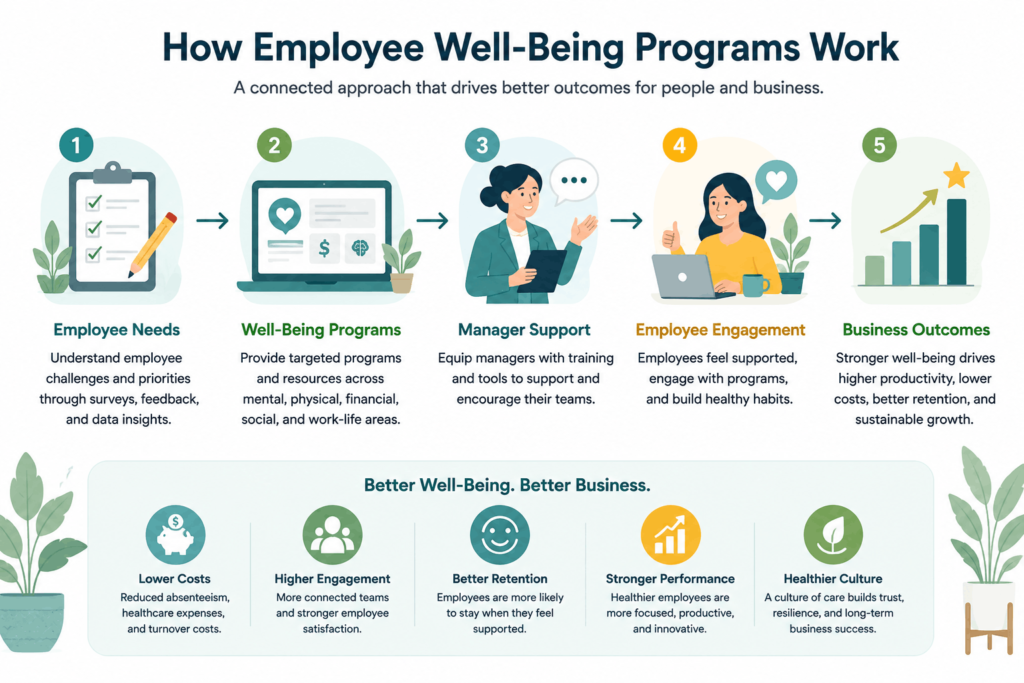
Corporate employee wellbeing programs combine technology, benefits, workplace policies, and leadership support. The most effective programs are integrated into everyday employee experience rather than treated as standalone initiatives.
Vendor selection. Organizations typically partner with specialized providers such as mental health platforms, fitness applications, or financial wellness services. Some employers prefer all-in-one platforms that cover multiple dimensions of wellbeing through a single solution.
Funding model. Most programs are employer-funded, although some organizations offer lifestyle spending accounts (LSAs) that allow employees to choose the wellbeing resources that best fit their needs.
Access and delivery. Digital and mobile-first programs tend to achieve higher participation rates, particularly in hybrid and remote workplaces. Easy access is one of the strongest predictors of utilization.
Manager involvement. Employees are significantly more likely to engage with wellbeing resources when managers actively support and promote them. Leadership participation helps reduce stigma and increases trust in the program.
Measurement. Successful organizations regularly monitor participation, engagement, retention, absenteeism, and other outcome metrics to understand what is working and where improvements are needed.
Best Employee Wellbeing Programs 2026
The strongest programs in 2026 share a few characteristics: they address multiple dimensions of well-being, they are accessible on mobile, they provide employer-facing analytics, and they reduce friction in accessing care.
Comprehensive mental health platforms:
- Modern Health — Licensed therapy, coaching, self-guided content, and group sessions in a single platform
- Lyra Health — AI-driven matching to vetted therapists and coaches with fast access timelines
- Spring Health — Data-driven care plans with clinical support and employer analytics
Holistic well-being platforms:
- Personify Health (formerly Virgin Pulse) — Physical, mental, financial, and social well-being with AI personalization
- Wellness360 — Built around eight pillars of wellness with strong employer reporting tools
- Wellable — Flexible, multimedia content library with digital and in-person program options
Engagement and fitness-focused tools:
- YuMuuv — Team-based wellness challenges with real-time leaderboards and high participation rates
- Headspace for Work — Guided meditation and mindfulness for workplace stress and focus
- Calm Business — Sleep, stress, and focus support through a well-known consumer app
“The best well-being programs start with understanding employee needs—not with choosing a platform.” | HR strategy insight
For organizations seeking online therapy access as part of their mental health offering, platforms like Calmerry offer structured therapist matching, flexible session scheduling, and employer reporting, making them a practical option for businesses seeking clinical-quality support without the complexity of a large platform implementation.
How to Choose the Right Well-Being Program
Use this checklist before selecting a program or platform:
Company size and structure
- Does the solution scale to the current headcount, with room to grow?
- Does it work across locations, time zones, and work arrangements?
- Is there a remote or hybrid-friendly delivery model?
Budget
- What is the total annual cost per employee?
- Are there modular options to start smaller and expand?
- What measurable savings offset the investment?
Employee needs
- Has an employee needs assessment been completed?
- Does the program address the top challenges employees identified?
- Are different demographic groups and life stages accounted for?
Goals and measurement
- Are KPIs defined, and baseline data available?
- Does the platform provide utilization reporting and outcome data?
- Can the vendor demonstrate results from comparable organizations?
Cultural fit
- Is leadership prepared to model participation?
- Are managers trained to support the program?
- Does the program design reduce stigma rather than reinforce it?
The Centers for Disease Control and Prevention and the World Health Organization both publish employer guidance on evidence-based well-being program design — useful reference points when evaluating vendor claims.
Best Practices for Implementing Well-Being Programs
- Align with business goals. Connect each program to a measurable business outcome — reduced absenteeism, lower turnover, improved engagement. This protects the budget when priorities shift.
- Start with an employee needs assessment. Build programs around what employees actually need, not what leadership assumes they need. Anonymous surveys are the most reliable starting point.
- Involve managers early. Manager training should precede any broader rollout. Teams take their cues on whether using well-being resources is acceptable from the people they report to.
- Communicate repeatedly. Most employees will not seek out a program they were told about once. Multi-channel communication at launch, plus regular reminders throughout the year, is essential for maintaining utilization.
- Reduce access barriers. Complex enrollment processes, multiple logins, and long wait times for support all suppress utilization. Choose programs with the lowest possible friction between the employee and the help they need.
- Make leadership visible. Senior leaders who speak openly about their own use of well-being resources normalize the behavior for the entire organization.
- Measure consistently. Set a quarterly review cadence and track the same metrics across periods. Trends matter more than point-in-time snapshots.
- Iterate based on data. A program with low utilization is a signal — poor communication, wrong format, wrong problem addressed, or a stigma barrier. Investigate and adjust rather than assuming the program is working.
How to Measure the Success
Measurement gives well-being programs organizational credibility. Without it, they stay in the budget at risk. With it, they become a defensible investment tied to business performance.
What Metrics Should Companies Track?
EAP or platform utilization rate
Shows awareness, accessibility, and employee participation.
Voluntary turnover rate
Measures retention impact over time.
Absenteeism rate
Tracks changes in sick leave frequency.
Employee engagement score
Measures motivation and discretionary effort.
95% of companies that measure the ROI of their wellness programs report positive returns, and 77% report an overall ROI greater than 100%. The challenge is not that well-being programs fail to deliver — it is that most organizations do not measure consistently enough to capture the returns.
Cost of Employee Well-Being Programs
Costs vary significantly based on program scope, delivery model, and company size. Here is a general framework for planning.
Basic EAP access — $15–$35 per employee annually
Mental health app subscription — $60–$240 annually
Comprehensive digital well-being platform — $200–$600 annually
Full clinical mental health platform — $400–$1,200 annually
Independent surveys show a mid-range average of approximately $742 per employee per year across all program types, though actual spend depends heavily on which components are included.
The National Institute of Mental Health notes that untreated mental health conditions generate substantial indirect costs for employers through absenteeism, reduced productivity, and disability claims. The cost of a program is almost always lower than the cost of the problems it prevents.
Common Mistakes Companies Make
Even well-resourced organizations make avoidable errors when designing and managing well-being programs. The most common patterns include:
- Launching without an HR strategy. A collection of disconnected initiatives is not a program. Without defined goals, KPIs, and clear ownership, well-being spending lacks accountability.
- One-time or seasonal initiatives. A mental health awareness event in May or a step challenge in January is not sustainable support. Employees need year-round access and year-round communication.
- No measurement from the start. Programs launched without baseline data cannot demonstrate impact. Measurement planning belongs before launch, not after.
- Skipping manager training. The manager relationship shapes the day-to-day employee experience more than any single benefit. Programs that bypass the manager layer consistently underperform.
- Poor communication. Benefits that are not actively promoted on a regular basis go unused. Most employees think about their EAP only when they are already in crisis, and if they do not know how to access it, they will not.
- Generic, one-size-fits-all design. Although 85% of workers have access to at least one wellness program, average usage rates remain around 30–35%. Low utilization is often a sign that programs are not matched to what specific employee groups actually need.
- Ignoring financial and social well-being. Mental and physical health programs are the most visible, but financial stress and social isolation are strong predictors of overall well-being outcomes. A program that addresses only one dimension leaves a significant impact on the table.
The American Psychological Association and Harvard Business Review both emphasize that the most effective well-being programs treat employee health as a systemic, organizational issue rather than an individual one, meaning the design of work, management culture, and organizational policies are all part of the equation.
FAQs
1. What are employee well-being programs?
They are structured, employer-sponsored initiatives designed to support employee health across multiple dimensions: mental, physical, financial, and social. They go beyond standard benefits to actively promote well-being through programs, tools, and policies.
2. What are the benefits of employee wellbeing programs?
For employees: access to meaningful support, reduced stress, stronger work-life balance, and a sense of being valued.
For employers: lower absenteeism, reduced turnover, improved productivity, lower healthcare costs, and a stronger employer brand.
3. How do corporate employee wellbeing programs work?
Organizations partner with well-being vendors or build internal programs, fund access for employees, train managers to support participation, and measure outcomes through regular reporting. Programs can be fully digital, in-person, or hybrid.
4. What are examples of employee well-being programs?
Examples include EAP access, therapy platforms, step challenges, financial coaching, mental health days, peer recognition tools, flexible scheduling policies, and manager mental health training programs.
5. How much do employee well-being programs cost?
Costs range from $15 per employee per year for basic EAP access to $1,200 or more for comprehensive clinical platforms. The mid-range average across all program types is approximately $742 per employee annually.
6. What are the best employee well-being programs in 2026?
Leading solutions include Modern Health, Lyra Health, Spring Health, Personify Health, Wellness360, and Headspace for Work, each offering different strengths across mental health, physical activity, and holistic well-being. The best choice depends on company size, budget, and employee needs.
7. What are financial well-being programs for employees?
Employee financial wellbeing programs provide tools and support for managing debt, budgeting, emergency savings, and retirement planning. Dealing with debt is now the top financial stressor for 68% of employees, making financial well-being support an increasingly important part of the overall well-being offering.
8. How can companies choose the right well-being program?
Start with an employee needs assessment to understand what challenges actually exist. Then evaluate solutions based on company size, budget, delivery model, integration with existing HR systems, and the vendor’s ability to provide outcome reporting. Match the program to the problem, not the other way around.