Mental Health Support for Nonprofit Organizations



Table of Contents
Nonprofit employees go to work every day motivated by a sense of purpose. They work with vulnerable communities, manage complex social problems, and often take on responsibilities well beyond their job descriptions, not because they are asked to, but because the mission demands it. That sense of purpose is one of the nonprofit sector’s greatest strengths. It is also one of the main reasons mental health support for employees in this sector gets overlooked for so long.
The numbers make the scope of the problem clear. 95% of nonprofit leaders surveyed in the Center for Effective Philanthropy’s 2024 report expressed concern about staff burnout, and 75% said burnout was at least partially affecting their organization’s ability to achieve its mission. This is not an individual wellness issue. It is an organizational risk that threatens program delivery, team stability, and long-term mission impact.
Nearly 7 in 10 nonprofit employees reported in a 2025 survey that they would be looking for a new job that year. For organizations already operating with lean teams and constrained budgets, that level of turnover intention is a serious operational threat. Mental health support for employees in the nonprofit sector is not a nice-to-have. For most organizations, it is the difference between a stable workforce and a perpetual staffing crisis.
Why Mental Health Is a Critical Issue in Nonprofit Organizations
The nonprofit workforce faces a combination of pressures that most private-sector employees do not encounter at the same intensity. Mission-driven work is emotionally demanding by nature. Many nonprofit employees work directly with people experiencing poverty, trauma, illness, or crisis. That daily exposure creates a specific kind of stress that accumulates over time.
At the same time, nonprofit organizations for mental health and broader social services consistently operate with underfunded teams. Staff are asked to absorb responsibility gaps when positions go unfilled, and they frequently do, because the work feels too important to let slide. In a 2023 National Council of Nonprofits survey, nearly 75% of nonprofits reported persistent job vacancies, particularly in program and service delivery roles.
Budget constraints create a secondary problem. Even leaders who recognize the mental health challenge often identify funding as the primary barrier to addressing it. Most foundation leaders reported some understanding of staff wellbeing concerns, but only half reported that their foundation engaged in practices to support staff well-being at the organizations they fund. The awareness exists. The resources frequently do not.
Burnout in Nonprofit Sector: Causes and Consequences
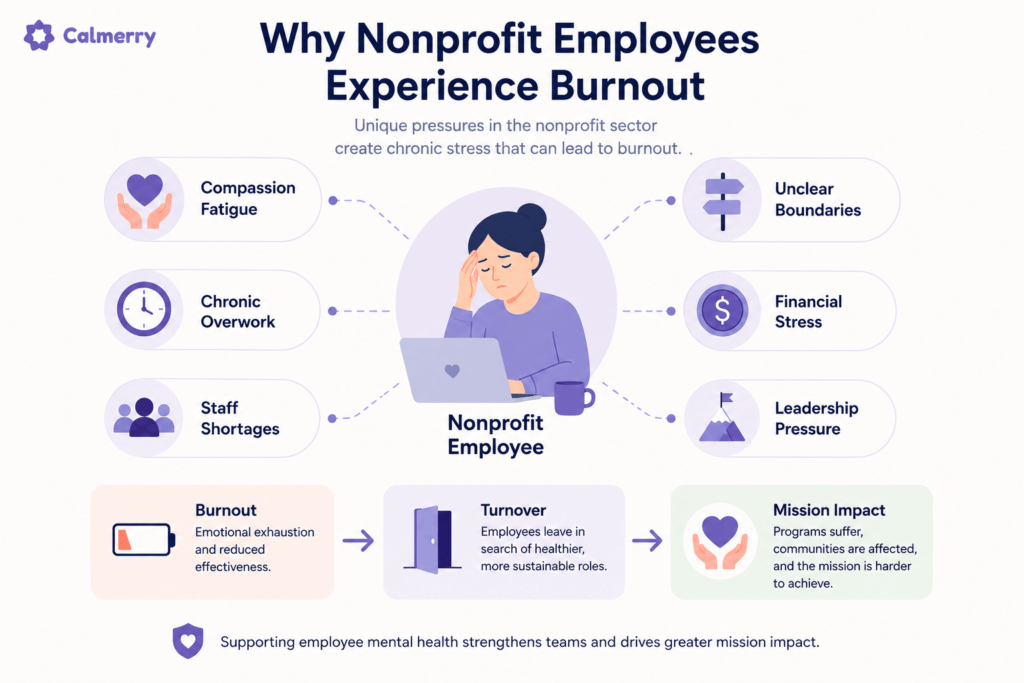
Burnout in the nonprofit sector follows a predictable pattern. It begins with high emotional investment and insufficient recovery time. Without structural support, it deepens into exhaustion, cynicism, and eventually departure.
The primary causes in nonprofit environments include:
- Compassion fatigue — Sustained exposure to others’ suffering creates emotional depletion that differs from ordinary work stress
- Chronic overwork — More than 50% of nonprofit leaders struggle to maintain work-life balance, and nearly 60% were dealing with staff burnout or attrition due to higher-paid offers elsewhere
- Unclear boundaries — Mission-driven culture can blur the line between dedication and unsustainable self-sacrifice
- Inadequate pay — In 2022, 22% of nonprofit employees lived in households unable to afford basic necessities like housing and healthcare — a financial stressor that compounds every other pressure
- Staff shortages — One in three nonprofits struggles with retention and turnover, and 59% reported significantly more difficulty filling staff positions in 2024 than in prior years, meaning remaining employees absorb additional load
- Leadership isolation — 33% of nonprofit leaders said they are “very much” concerned about their own burnout, with half reporting they are more concerned now than the previous year
The American Psychological Association defines burnout as a response to chronic workplace stress that has not been successfully managed — characterized by exhaustion, increasing mental distance from work, and reduced professional effectiveness. In the nonprofit sector, all three dimensions are common.
“Burnout is rarely the result of a lack of commitment. More often, it is the result of sustained commitment without sufficient support.” | Workplace mental health insight
The Impact of Mental Health on Nonprofit Employee Retention
Retention is where unaddressed mental health strain creates the most visible organizational damage. Losing a trained employee is expensive in any sector. In nonprofits, where institutional knowledge, community relationships, and program continuity are critical, costs are often higher.
Voluntary turnover
Replacing an employee can cost between 33% and 200% of their annual salary when hiring, onboarding, training, and lost productivity are taken into account.
Burnout-related departures
The nonprofit sector’s turnover rate is approximately 19%, compared to 12% in other sectors, highlighting the impact of chronic stress and burnout.
Recruitment difficulty
Nearly 59% of nonprofits reported significantly greater difficulty filling open positions in 2024 than in previous years.
Mission impact
Staff burnout affects more than employee wellbeing. 76% of nonprofit leaders report that burnout is limiting their organization’s ability to achieve its mission.
Program continuity
Every frontline employee departure can disrupt client relationships, delay services, and negatively affect program outcomes.
Leadership pipeline
Declining interest in senior nonprofit roles makes it harder to build future leadership capacity and creates additional retention challenges at the top of the organization.
Nonprofit employee retention is not, at its root, a recruitment problem. It is a workplace conditions problem. Organizations that invest in mental health support for employees see measurable improvements in retention, and the cost savings from lower turnover typically exceed the cost of the programs themselves.
Nonprofit Workplace Stress: What Makes It Different
Nonprofit workplace stress is not simply a higher-volume version of what private-sector employees experience. The sources and texture of it are distinct.
Mission alignment creates a specific vulnerability. Employees who are deeply committed to a cause find it harder to set limits on their workload and harder to disconnect when they step away from the office. The cause always needs more, and people who care deeply feel the pull of that need.
Secondary traumatic stress is a recognized occupational hazard in social services, healthcare, and community development work. Staff absorb the emotional weight of the clients and communities they serve. Over time, this exposure produces symptoms that mirror those of direct trauma, without the employee having experienced the event themselves.
Organizational culture in nonprofits sometimes inadvertently reinforces overwork. Language around sacrifice, dedication, and mission can create an unspoken pressure to push past reasonable limits. Employees who do take mental health days or ask for support sometimes feel they are betraying the cause.
Finally, the underfunding reality means fewer resources to address problems when they surface. Private employers can deploy a new platform or expand a benefit relatively quickly. Nonprofits often need to identify low-cost or no-cost options and build internal capacity to deliver them.
Mental Health Support for Nonprofit Employees: What Teams Actually Need
Effective nonprofit employee mental health support does not require enterprise-scale investment. It requires understanding what the workforce is actually experiencing and matching solutions to those specific needs.
The most commonly identified needs in nonprofit teams include:
- Access to confidential therapy or counseling — a space outside the organization to process emotional and professional stress
- Manager training in burnout recognition — supervisors who can identify early warning signs and respond supportively
- Peer support structures — normalized, low-barrier channels for collegial support within the team
- Workload boundaries and policies — structural changes that reduce the conditions that generate burnout in the first place
- Psychological safety — a culture where employees can disclose struggles without risk to their professional standing
- Flexible scheduling — flexibility as both a practical accommodation and a signal of organizational care
The National Institute of Mental Health emphasizes that untreated mental health conditions generate measurable workplace costs through reduced performance, higher absenteeism, and increased turnover — all of which nonprofits can afford least.
Types of Mental Health Services for Nonprofits
Employee Assistance Programs (EAPs)
What it includes
- Short-term counseling
- Crisis support
- Legal and financial referrals
Typical cost
$15–$35 per employee annually
Best for
Organizations seeking affordable baseline mental health coverage.
Online Therapy Platforms
What it includes
- Licensed therapist access
- Video, phone, or text sessions
- Flexible scheduling
Typical cost
$60–$300 per employee annually
Best for
Organizations that need ongoing clinical support, especially for hybrid and remote teams.
Peer Support Networks
What it includes
- Trained internal advocates
- Informal emotional support
- Community-building initiatives
Typical cost
Low cost, primarily training-related expenses
Best for
Organizations looking to strengthen workplace culture with limited budgets.
Manager Mental Health Training
What it includes
- Burnout recognition training
- Mental health conversations
- Early intervention techniques
Typical cost
$500–$3,000 per training cohort
Best for
Organizations where manager behavior significantly influences employee wellbeing.
Digital Well-Being Apps
What it includes
- Stress-management tools
- Mindfulness exercises
- Sleep and resilience resources
Typical cost
$5–$15 per employee per month
Best for
Organizations seeking scalable, low-cost support for a large workforce.
Group Therapy and Support Groups
What it includes
- Facilitated group sessions
- Peer connection
- Support around shared challenges such as compassion fatigue and burnout
Typical cost
Varies by provider and program structure
Best for
Organizations where employees face similar stressors or emotionally demanding work.
“The most effective nonprofit mental health strategy is rarely built around a single service. Organizations achieve the best outcomes when multiple forms of support work together.” | Nonprofit workforce wellbeing insight
Affordable Mental Health Solutions for Nonprofits
Budget constraints are real in the nonprofit sector. The good news is that meaningful support does not require a large per-employee budget. Several affordable mental health services for nonprofits generate strong outcomes at manageable costs.
Accessible options at different price points:
- EAP through existing health plan — many nonprofit health insurance plans include basic EAP access at no additional cost; the first step is finding out whether it is already available
- Nonprofit-specific discounts from mental health platforms — several digital therapy providers offer discounted rates for registered nonprofits; it is worth asking vendors directly
- Subsidized access through community mental health organizations — local community mental health centers sometimes offer sliding-scale or organizational rate agreements for nonprofit partners
- Free manager training resources — the American Psychological Association, Mental Health America, and the Centers for Disease Control and Prevention all publish free employer toolkits for supporting workforce mental health
- Peer support program development — training a small cohort of internal mental health champions using free or low-cost certification programs creates lasting organizational capacity
- Mental health days — formalizing mental health days as part of PTO policy costs nothing and signals a genuine organizational commitment
- Flexible scheduling — remote or hybrid work, where feasible, removes commute stress and increases autonomy, two documented drivers of wellbeing improvement
The World Health Organization notes that even low-cost mental health interventions, when well communicated and consistently available, can yield measurable improvements in productivity and workforce stability.
Online Therapy for Nonprofit Organizations
Online therapy for nonprofit organizations is one of the most practical and affordable mental health services available to the sector. Digital platforms eliminate several of the barriers that traditionally suppressed workplace support utilization in nonprofits.
Geographic accessibility. Nonprofit teams are often distributed across communities, regions, or countries. Online therapy reaches every team member regardless of location, without requiring travel or local provider availability.
Scheduling flexibility. Nonprofit employees frequently work irregular hours or carry high caseloads. Asynchronous text-based therapy and evening session availability accommodate schedules that do not fit a traditional nine-to-five model.
Stigma reduction. Accessing support through a personal device feels less exposing than calling a hotline or visiting an office that colleagues might notice. Lower barriers to access produce higher utilization.
Cost-effectiveness. Per-session pricing models mean nonprofits pay only for support that employees actually use, making digital therapy one of the most cost-effective options for smaller organizations without predictable utilization rates.
Platforms like Calmerry offer access to licensed therapists, flexible session scheduling, and employer-facing reporting. For nonprofit organizations that need clinical quality at accessible price points, this kind of digital-first model is worth evaluating before committing to more expensive enterprise solutions.
Workplace Mental Health Benefits for Nonprofits
Even with limited budgets, nonprofits can build a meaningful set of workplace mental health benefits for their teams. The key is prioritizing communication and access over volume of offerings.
Mental Health Days
What it looks like
Formally designated paid days that allow employees to recover from stress and prevent burnout.
Cost level
Minimal or none when implemented through existing PTO policies.
EAP Access
What it looks like
Confidential short-term counseling, crisis support, and referral services.
Cost level
Low.
Online Therapy Access
What it looks like
Access to licensed therapists through a digital mental health platform with flexible scheduling.
Cost level
Low to medium.
Manager Training
What it looks like
Training managers to recognize burnout, support employees effectively, and have constructive mental health conversations.
Cost level
Low to medium.
Flexible Scheduling
What it looks like
Remote work options, adjusted schedules, flexible hours, and no-meeting days.
Cost level
Minimal or none.
Peer Support Networks
What it looks like
Trained internal mental health champions who provide guidance and peer connection.
Cost level
Low, primarily training-related.
Psychological Safety Culture
What it looks like
Leadership modeling healthy behaviors, encouraging open communication, and reducing stigma around mental health discussions.
Cost level
None.
“The most effective nonprofit mental health benefits are not always the most expensive. Often, the greatest impact comes from creating a culture where employees feel safe asking for support.” | Nonprofit workplace wellbeing insight
The Harvard Business Review has consistently documented that employees who feel psychologically safe in their workplace demonstrate higher employee engagement, better performance, and significantly lower turnover — all without any direct financial investment.
How Nonprofits Can Implement Mental Health Programs
Building mental health programs for nonprofit employees does not require a dedicated HR team or a large annual budget. A structured, phased approach makes it achievable for most organizations.
Step 1: Assess employee needs. Run a short anonymous survey to understand what employees are experiencing. Ask about stress levels, barriers to accessing support, and what types of help would be most useful. Do not assume — the answers often differ from leadership’s assumptions.
Step 2: Identify what is already available. Before purchasing anything, audit existing benefits. Many organizations have EAP access, but they do not communicate clearly. Check the health plan, any existing vendor contracts, and free mental health resources from public health organizations.
Step 3: Choose one or two high-impact solutions. Starting with too many programs creates communication complexity and dilutes utilization. Identify the most critical need from the assessment and address it directly. Add programs incrementally as the first ones become established.
Step 4: Communicate clearly and repeatedly. Benefits that employees do not know about go unused. Use multiple channels — staff meetings, email, Slack, onboarding materials — and repeat the information regularly throughout the year. Include how to access the support, not just that it exists.
Step 5: Train managers first. Before the broader launch, equip supervisors with the language and tools to support their teams. A manager who normalizes mental health conversations is worth more than any digital platform deployed without cultural reinforcement.
Step 6: Monitor, gather feedback, and adjust. Set a simple tracking cadence. Review what is being used. Ask employees what is working. Adjust based on what the data shows, not what the program design assumed.
Common Mistakes Nonprofits Make
Even well-intentioned organizations fall into avoidable patterns when addressing workforce mental health.
- Treating wellness events as a mental health strategy. A staff retreat or mindfulness workshop is a positive gesture, not a program. One-time initiatives do not address structural stress or provide ongoing access to support.
- Communicating benefits only at onboarding. New employees hear about the EAP on day three and never again. Regular, repeated communication is essential for sustained utilization.
- Assuming staff will self-identify and seek help. Stigma, workload, and mission culture all suppress help-seeking behavior. Proactive outreach and manager involvement matter more than passive availability.
- Not budgeting for mental health at all. When mental health support is not a line item, it gets cut first. Even a small, protected budget signals organizational commitment and enables planning.
- Focusing only on individual-level interventions while ignoring organizational conditions. Access to therapy and mindfulness apps are valuable. They do not fix understaffing, unrealistic workloads, or a culture that equates overwork with dedication. Both levels need attention.
- Skipping measurement. Without tracking turnover rates, absenteeism, and program utilization, there is no basis for demonstrating impact or making the case for continued investment.
FAQs
1. What mental health support do nonprofit employees need?
Nonprofit employees most frequently need access to confidential therapy or counseling, manager training in burnout prevention, peer support structures, workload boundaries, and a workplace culture where seeking help is normalized.
2. Why is burnout common in nonprofit organizations?
Burnout in the nonprofit sector stems from high emotional demands, mission-driven overwork, inadequate pay, chronic understaffing, and compassion fatigue from sustained contact with vulnerable populations. 95% of nonprofit leaders cited burnout as a major challenge in 2024.
3. How does mental health affect nonprofit employee retention?
Directly and significantly. The nonprofit sector’s annual turnover rate is approximately 19%, compared to 12% in other sectors — a gap largely driven by burnout and inadequate well-being support. Replacing each departing employee costs between 33% and 200% of their annual salary.
4. What are affordable mental health services for nonprofits?
Affordable options include EAP access through existing health plans, online therapy platforms with nonprofit pricing, development of a peer support network, free manager training resources from the American Psychological Association and the CDC, mental health days, and flexible scheduling policies.
5. Can nonprofits use online therapy platforms?
Yes, and online therapy for nonprofit organizations is often the most practical option. Digital platforms offer geographic flexibility, scheduling convenience, stigma reduction, and per-session pricing models that avoid the fixed costs of enterprise subscriptions.
6. What are the best mental health programs for nonprofit employees?
Programs that combine accessible therapy, manager training, peer support, and clear communication policies consistently outperform single-intervention approaches. The best programs for any organization are built around actual employee needs, which requires an assessment before selecting solutions.
7. How can nonprofits support employee wellbeing with limited budgets?
Start with what is already available. Audit existing health plan benefits for EAP access. Use free public resources for manager training. Formalize mental health days within existing PTO. Then add one paid solution — ideally a digital therapy platform — that addresses the most critical identified need.
8. What are workplace mental health benefits for nonprofit teams? Mental health benefits for nonprofit employees do not require a large investment to be meaningful. Mental health days, EAP access, online therapy, flexible scheduling, peer support networks, and manager training are all accessible at various price points, and together they form a comprehensive foundation for workforce wellbeing.