Employee Well-Being Strategy: How to Build, Implement, and Measure ROI



In this article
Most companies have some form of wellness offering. A gym reimbursement, an EAP buried in the benefits package, maybe a meditation app. What most companies don’t have is a strategy. The difference matters more than it might seem.
According to the American Psychological Association’s 2024 Work in America survey, 67% of workers experienced at least one outcome associated with workplace burnout in the past month, including low energy, lack of motivation, and feelings of isolation. These are not personal problems. They are organizational ones. And they show up directly in absenteeism, turnover, and productivity data.
“Employee well-being is no longer a workplace perk it is a business performance strategy.” | Workplace well-being insight
A corporate wellbeing strategy is not a benefits list. It is a coordinated, measurable approach to building a workforce that is healthy, engaged, and productive over the long term. Companies that treat well-being as a strategic priority, not a perk, are seeing the difference in their retention rates, healthcare costs, and business performance. This guide explains how to build that strategy from the ground up.
What Is an Employee Wellbeing Strategy?
The term gets used loosely. Separating the concepts helps employers make better decisions about where to invest and what to measure.
Well-being Strategy
A coordinated, organization-wide plan with defined goals, KPIs, and accountability.
Example:
A three-year roadmap designed to reduce burnout and improve retention by 20%.
Well-being Programs
Specific initiatives that provide direct support to employees.
Examples:
Therapy access, financial counseling, wellness challenges, and stress management resources.
Well-being Benefits
Compensation-linked offerings included in the employee benefits package.
Examples:
Mental health days, EAP access, and healthcare coverage.
A strategy connects all three. It defines what the organization is trying to achieve, which programs will get it there, and how benefits are structured to support the overall goal. Without the strategy layer, programs and benefits tend to operate in silos — well-intentioned but difficult to measure and easy to cut when budgets tighten.
An employee health and wellbeing strategy also gives HR teams a framework to prioritize. Not every organization needs the same mix of programs. A strategy built on actual employee data produces better outcomes than one copied from a competitor’s benefits page.
Why Companies Need a Well-Being Strategy
The cost of doing nothing is not zero. Poor employee well-being generates expenses that show up across multiple business functions simultaneously.
Burnout
Only 31% of U.S. employees were engaged in 2024 — the lowest level in a decade. Disengagement affects productivity, innovation, and customer experience.
Absenteeism
Companies with comprehensive wellness programs report 56% fewer sick days among employees.
Turnover
Replacing an employee may cost six to nine months of salary when hiring, onboarding, and lost productivity are factored in.
Presenteeism
Employees working while mentally exhausted often perform below capacity, creating hidden productivity losses that HR metrics frequently miss.
Healthcare Costs
According to HR leaders, 91% reported reduced healthcare costs after implementing wellness initiatives.
Research shows 87% of workers choose employers based on health and wellness offerings. The employee well-being strategy is, increasingly, a talent acquisition tool as much as a retention one.
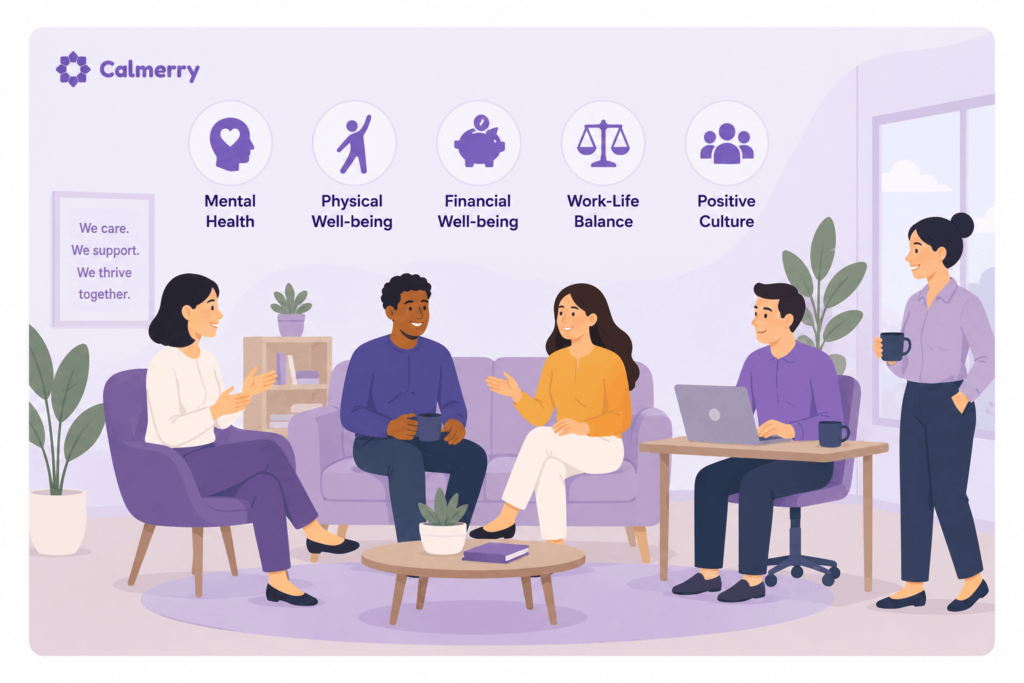
Effective workplace well-being strategies support employees across multiple dimensions of health and workplace experience.
Core Elements of an Employee Well-Being Strategy
A complete employee health and wellbeing strategy addresses five interconnected dimensions. Focusing on only one or two typically produces weak results because the dimensions reinforce each other.
Mental Health Support
Includes therapy access, EAPs, stress management resources, and manager training.
Business impact:
Reduced absenteeism, lower turnover, and stronger employee engagement.
Physical Well-being
Includes fitness benefits, preventive healthcare, ergonomic support, and sick leave policies.
Business impact:
Fewer healthcare claims and lower absenteeism.
Financial Well-being
Includes financial counseling, emergency savings support, and transparent compensation practices.
Business impact:
Reduced financial stress and improved productivity.
Work-Life Balance
Includes flexible schedules, remote work options, PTO culture, and mental health days.
Business impact:
Burnout prevention and stronger retention.
Workplace Culture
Includes psychological safety, DEI initiatives, recognition programs, and open communication.
Business impact:
Higher engagement, better collaboration, and stronger innovation.
According to Macorva’s 2024 report, 92% of employers now include emotional or mental health support in their well-being offering, while 77–83% include financial wellness benefits. Coverage is increasing, but coverage alone does not equal a strategy. These elements need to be connected, communicated clearly, and tracked consistently.
“Offering benefits is not the same as building a culture that supports employee well-being.” | HR leadership insight
Employee Wellbeing Strategy Examples
Different organizations structure their approach based on their size, workforce, and business priorities. The following examples show how a corporate wellbeing strategy can look across different contexts.
Large Tech Company
Strategy focus: Mental health and flexibility
Key initiatives:
25 free therapy sessions annually, mental health days, remote-first policies.
Reported results:
Higher utilization of mental health benefits and improved retention.
Global Professional Services Firm
Strategy focus: Manager-led well-being culture
Key initiatives:
Manager mental health training and EAP engagement tied to HR metrics.
Reported results:
Improved employee engagement scores.
Mid-size Healthcare Organization
Strategy focus: Burnout prevention
Key initiatives:
Workload audits, peer support groups, and mandatory recovery periods.
Reported results:
Reduced sick day frequency among staff.
Fast-growing Startup
Strategy focus: Scalable support
Key initiatives:
Mental health app subscriptions, flexible PTO, and open leadership conversations.
Reported results:
Stronger employer brand and lower early attrition.
Small Business
Strategy focus: Accessible low-cost support
Key initiatives:
EAP access through healthcare plans, mental health days, and manager toolkits.
Reported results:
Improved trust and reduced turnover.
The common thread across each example is intentionality. Each organization defined what it was trying to achieve before choosing its programs. The results followed from the structure, not from the budget size.
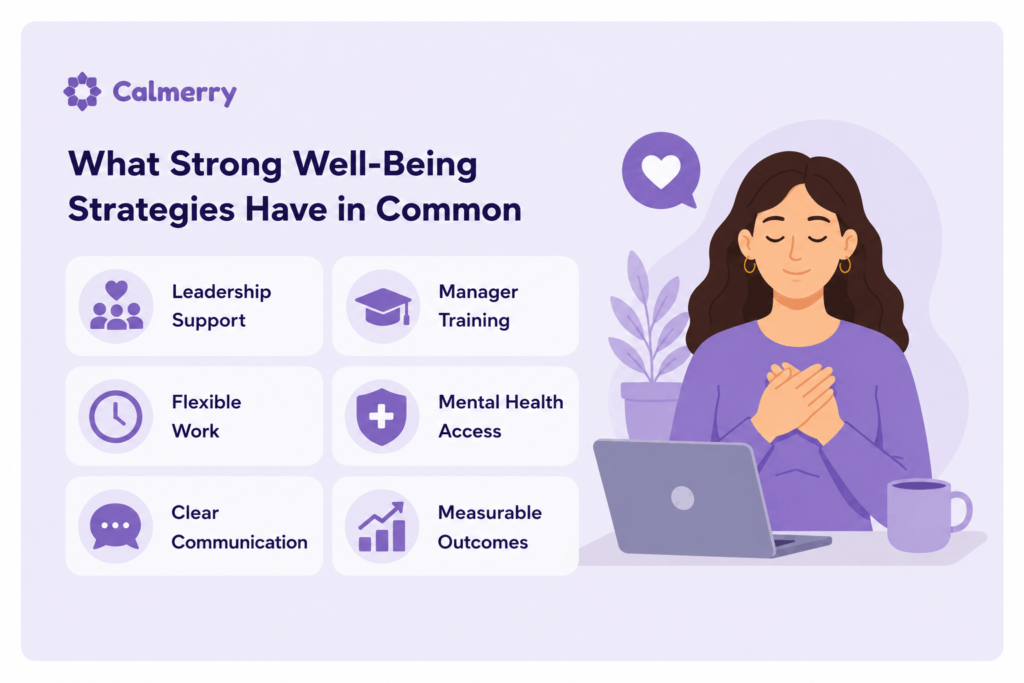
How to Build an Employee Well-Being Strategy: Step-by-Step
Step 1: Assess Employee Needs
Start with data, not assumptions. Run anonymous surveys across teams and departments to understand what employees are actually experiencing — stress levels, barriers to accessing support, awareness of existing benefits, and areas where they feel least supported.
Segment the data where possible. Frontline workers have different stressors than remote knowledge workers. What shows up in one department may not reflect the organization as a whole. The assessment becomes the baseline against which future progress is measured.
Step 2: Define Goals and KPIs
Before building anything, define what success looks like. Goals should be specific, time-bound, and tied to business outcomes.
Examples of measurable well-being KPIs:
- Reduce voluntary turnover by 15% within 12 months
- Increase EAP utilization rate from 5% to 15% by the end of the year
- Reduce average sick days per employee from 8 to 6 annually
- Improve employee engagement score by 10 points within two survey cycles
- Lower healthcare claims cost per employee year-over-year
KPIs without baselines are not useful. Measure before you launch, then track quarterly.
Step 3: Choose Programs and Tools
Match the program mix to what the assessment revealed. A workforce reporting high financial stress needs different support than one reporting social isolation or workload burnout.
Key selection criteria:
- Accessibility (mobile, multilingual, remote-friendly)
- Clinical quality for any therapy-based offering
- Integration with existing HR and benefits systems
- Vendor reporting and outcome data
- Cost per employee relative to projected impact
Step 4: Align With Business Goals
An HR strategy that sits outside the business strategy will always be vulnerable to budget cuts. Connect each initiative to a business outcome. Reduced absenteeism connects to operational efficiency. Lower turnover connects to recruitment cost savings. Higher engagement connects to customer satisfaction and revenue.
When HR can present well-being spending as a business investment, with projected and actual returns, it shifts from a cost center to a performance lever.
“The organizations seeing the strongest results treat employee well-being as an operational investment not an optional benefit.” | Workplace strategy insight
Step 5: Launch and Communicate
Rollout quality shapes utilization more than program quality in many cases. A strong benefit that employees don’t know about is not a benefit. Communication should be multi-channel, repeated regularly, and include visible leadership endorsement.
Effective launch communication includes:
- A clear explanation of what is available and how to access it
- A message from senior leadership that normalizes using the support
- Manager briefings so teams hear it from someone they trust
- Follow-up reminders at 30, 60, and 90 days post-launch
Step 6: Measure and Optimize
Review metrics quarterly. Compare against the baselines set in Step 2. Identify which programs are being used and which are not. Gather qualitative feedback through short pulse surveys.
Adjust based on what the data shows. A program with low utilization may need better communication, a different access model, or replacement with something that better fits the workforce. Iteration is not a sign of failure — it is how strategy matures.
Employee Wellbeing Strategy Template
Use this structure as a starting point. Adapt the specific components to your workforce size, industry, and budget.
Section 1: Foundation
- Organizational context and workforce demographics
- Summary of employee needs assessment findings
- Top three well-being challenges identified
Section 2: Strategic Goals
- Primary well-being objectives (tied to business outcomes)
- KPIs and baseline measurements for each
- Target timelines
Section 3: Program Components
- Mental health support programs and the access model
- Physical well-being initiatives
- Financial well-being resources
- Work-life balance policies
- Culture and psychological safety initiatives
Section 4: Implementation Plan
- Launch timeline by program
- Communication plan and channels
- Manager training requirements
- Budget allocation by program type
Section 5: Measurement Framework
- Metrics tracked and reporting frequency
- Data sources (HR systems, surveys, claims data)
- Quarterly review process
- Annual strategy review and refresh cycle
Section 6: Accountability
- Program owner by initiative
- Executive sponsor
- Board or leadership reporting cadence
How to Implement a Well-Being Strategy in Your Company
Implementation is where most strategies lose momentum. A few structural decisions make a significant difference.
Assign clear ownership. Every program needs a named owner — someone accountable for utilization, communication, and results. Without ownership, programs drift.
Train managers first. Managers are the most influential variable in employee well-being. Only 29% of employees report working in an environment where managers actively encourage them to take care of their mental health. Manager training should precede any broader rollout, not follow it.
Reduce access barriers. Complexity kills utilization. If employees need three logins, a referral, and a two-week wait to access support, most will not bother. Prioritize programs with the lowest friction and the fastest path to help.
Make leadership visible. When senior leaders talk openly about using well-being resources, stigma drops and utilization rises. This is one of the highest-leverage actions an organization can take at no additional cost.
Integrate well-being into HR processes. Onboarding, performance reviews, and team meetings are all opportunities to normalize well-being conversations. When it is woven into the regular rhythm of the business rather than treated as a separate initiative, it becomes part of the culture.
How to Manage Employee Wellbeing Programs
Ongoing management is different from implementation. Once programs are live, the work shifts to monitoring, adjusting, and maintaining engagement over time.
Core management practices:
- Monthly utilization reviews — Track which programs are being used and which are not
- Quarterly pulse surveys — Short, anonymous check-ins on how employees are feeling and what they need
- Manager check-ins — Regular conversations with team leads about what they are observing
- Vendor performance reviews — Hold program providers accountable for the outcomes they promised
- Annual strategy review — Reassess the full strategy against the original goals and refresh the plan for the coming year
Well-being programs launched and left alone tend to plateau within 6 to 12 months. Active management sustains engagement and catches problems before they become systemic.
Platform solutions like Calmerry provide employer dashboards with utilization and outcome reporting, making the management layer significantly more practical for HR teams without large dedicated wellness staff.
Measuring ROI Workplace Mental Health Programs
Measurement is the step most organizations skip, and it is the reason well-being budgets are often the first to be cut. Tracking the right metrics builds the internal case for continued investment.
The ROI formula is straightforward: subtract the total program cost from the total measurable savings (reduced sick days, lower turnover costs, reduced claims), then divide by program cost. According to Wellhub’s 2024 Return on Well-being report, 95% of companies measuring the ROI of corporate wellness programs see positive returns, and 24% achieve returns of 150% or more.
ROI of Workplace Mental Health Programs
Mental health-specific investment is where the research is most detailed and the returns most documented.
Deloitte‘s review of 26 studies found that employers generate an average return of £4.70 for every £1 invested in improving workplace mental health. For universal programs, those available to all employees rather than targeted at high-risk groups, the return rises to £6.30 per £1 spent.
Wellness programs generate $3.27 in medical savings and $2.73 in absenteeism reductions for every $1 invested. When productivity gains are layered on top, the total return is substantially higher.
The mental health ROI for employers is particularly strong when intervention happens early. Reactive support, providing care after a mental health crisis occurs, is more expensive and less effective than proactive programs that reduce the likelihood of crisis in the first place. Burnout prevention, manager training, and psychological safety initiatives all fall into the proactive category and consistently deliver stronger returns than reactive clinical support alone.
The World Health Organization and the Centers for Disease Control and Prevention both publish employer guidance frameworks for workplace mental health investment. Both emphasize the link between organizational working conditions and mental health outcomes, framing mental health not as an individual issue but as a workplace design issue.
Common Mistakes in Well-Being Strategy
Even well-resourced organizations make avoidable errors. The most common ones share a pattern: good intentions without structural follow-through.
- One-time initiatives with no continuity. A mental health awareness month is not a strategy. It briefly raises visibility, then fades. Sustainable well-being requires year-round programming and consistent communication.
- No measurement from the start. Without a baseline, there is no way to demonstrate impact. Measurement planning should happen before launch, not after.
- Misalignment with business goals. Well-being programs that cannot be connected to productivity, retention, or cost savings are difficult to defend in budget conversations. The link to business outcomes needs to be explicit.
- Ignoring managers. Individual employee programs fail at higher rates when managers are not equipped to support the culture around them. Manager training is not optional — it is foundational.
- Low visibility and poor communication. Benefits that are not actively communicated on a regular basis go unused. Most employees don’t think about their EAP until they need it, and they won’t know how to access it unless they have been reminded recently.
- Treating all employees the same. A single program designed for the average employee rarely serves any employee particularly well. Segmentation by role, location, life stage, or identified need significantly improves both utilization and outcomes.
How to Choose the Right Well-Being Strategy for Your Business
Use this checklist before committing to a strategy or platform:
Company size and structure
- Does the solution scale to current headcount and projected growth?
- Does it work across multiple locations or time zones if relevant?
- Is there a model for remote or hybrid teams?
Budget
- What is the total cost per employee per year, including implementation?
- Are there lower-cost entry points that can scale over time?
- What measurable savings will offset the investment?
Employee needs
- Has an employee needs assessment been completed?
- Does the strategy address the top three challenges identified?
- Are different employee segments accounted for?
Goals and measurement
- Are KPIs defined before launch?
- Is baseline data available for comparison?
- Does the vendor provide reporting and outcome data?
Cultural fit
- Is leadership committed to visible participation?
- Are managers equipped to support the strategy?
- Does the program design reduce stigma rather than reinforce it?
The American Psychological Association publishes annual research on workplace well-being that is worth reviewing during the strategy selection process. Their Work in America survey data provides useful benchmarks for understanding where a given workforce sits relative to national trends.
FAQs
1. What is an employee well-being strategy?
It is a coordinated, organization-wide plan that defines how a company will support employee health and well-being, including specific programs, benefits, KPIs, and a process for measuring outcomes over time.
2. How do you build an employee well-being strategy?
Start with an employee needs assessment, then set measurable goals, select programs that address identified challenges, align the strategy with business objectives, launch with strong communication, and measure results regularly.
3. What should be included in a well-being strategy?
A complete strategy covers mental health support, physical well-being, financial well-being, work-life balance policies, and workplace culture initiatives, along with an implementation plan, KPIs, and a governance structure.
4. How do you measure the ROI of employee wellbeing programs?
Track metrics including absenteeism, voluntary turnover, healthcare claims, EAP utilization, and employee engagement scores. Compare before and after program implementation using a consistent measurement framework reviewed quarterly.
5. Are well-being strategies worth it for companies?
Consistently, yes. 95% of companies that measure ROI report positive returns from their wellness programs. The investment pays back through reduced sick days, lower turnover costs, improved productivity, and decreased healthcare spend.
6. What are examples of employee well-being strategies?
Examples range from enterprise-level programs with dedicated clinical support and manager training to small business approaches built on flexible PTO, EAP access, and free mental health resources. The common factor in effective examples is that they are built around actual employee data rather than assumed needs.
7. How can small businesses implement well-being strategies?
Start with what is already available — many health plans include EAP access at no additional cost. Add a clear mental health days policy, run a short needs assessment survey, and invest in one or two manager training sessions. Prioritize communication over program volume.
8. What metrics should companies track for well-being programs?
Core metrics include absenteeism rate, voluntary turnover, healthcare claims cost, program utilization, employee engagement scores, and manager-level satisfaction ratings. Add presenteeism measures for a more complete picture of hidden costs.