Employee Assistance Program (EAP): How It Works and What Employers Should Know



In this article
Most companies have an EAP. Most employees never use it. That gap is one of the defining problems in workplace mental health today, not a lack of investment, but a lack of utilization. According to SHRM’s 2024 research, 82% of U.S. businesses now offer an Employee Assistance Program, yet active annual utilization consistently runs between 10% and 20% of covered employees. The majority of workers at organizations that pay for EAP access never use it.
This guide explains the employee assistance program definition, where EAPs still make sense, their limitations, and how modern mental health platforms are changing employers’ expectations for employee support. The goal is not to dismiss EAPs, but to help employers make an informed decision about how to use them and when something more might be needed.
What Is Employee Assistance Program (EAP)?
An employee assistance program (EAP) is an employer-funded benefit that provides employees with confidential, short-term support for personal and work-related challenges. Traditionally delivered by phone or in person, EAP employee assistance program services cover mental health counseling, crisis support, legal referrals, and financial guidance — all at no direct cost to the employee.
EAPs originated in the 1940s, initially focused on alcohol-related issues in industrial workplaces. Over the following decades, their scope expanded significantly. Today, the employee assistance program EAP covers a broad range of life challenges, from anxiety and relationship difficulties to debt management and childcare referrals.
According to the U.S. Bureau of Labor Statistics, 61% of all workers had access to an EAP in 2024. It remains one of the most widely deployed workplace mental health benefits. The question is not whether EAPs are common — it is whether they are working.
Why Companies Still Use EAPs in 2026
EAPs persist for good reasons. They are cost-effective at a per-employee level, easy to administer through existing benefits infrastructure, and provide a legally and clinically defensible foundation for workplace mental health support.
For employers navigating compliance requirements, risk management, or crisis response, an EAP provides a structured, documented mechanism for supporting employees in distress. The EAP service market was estimated at $7.39 billion in 2024 and is projected to reach $10.40 billion by 2030 — growth driven largely by modernized models that integrate digital tools into the traditional framework.
EAPs also serve as a low-barrier entry point. A small business that cannot afford a comprehensive mental health platform can still provide employees with access to confidential counseling and crisis support through a basic EAP at a manageable cost.
“The value of an EAP is not that every employee uses it — it is that support is available when employees need it most.” | Workplace mental health insight
What’s Typically Included in an EAP
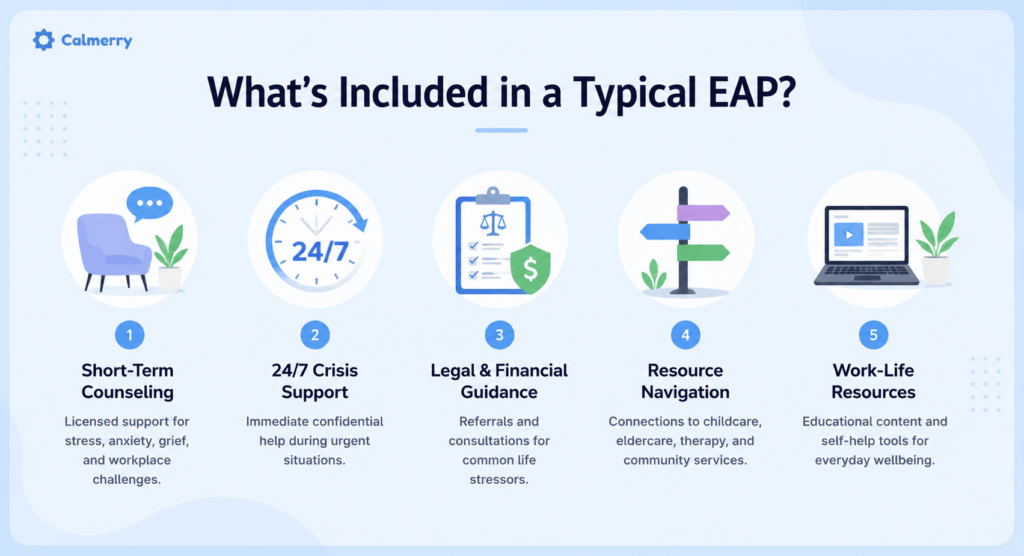
Employee assistance program EAP services vary by provider, but most cover the following categories:
Short-term counseling. The most commonly used EAP service. Employees receive a limited number of sessions, typically three to eight, with a licensed counselor for issues including anxiety, depression, grief, relationship difficulties, and workplace stress. Nearly eight out of ten EAP referrals are now for mental health counseling.
Crisis support. A 24/7 crisis hotline staffed by trained professionals. This is the EAP’s clearest value proposition — immediate, confidential support in moments of acute distress, available at any hour.
Legal and financial advice. 64% of EAPs provide employees with financial assistance, and 58% offer legal referrals. These services address two of the most common non-clinical sources of workplace stress.
Referral services. EAPs connect employees to community resources, long-term therapy providers, substance use treatment, childcare, and eldercare resources. The EAP functions as a navigator to a broader support ecosystem.
Work-life resources. Many EAPs include self-help tools, online resources, and educational content on topics such as stress management, nutrition, and parenting.
The Real Employee Assistance Programs EAP Benefits
When EAPs are well-communicated and accessible, they deliver real value — both to employees who need support and to organizations managing workforce risk.
Confidential mental health access — employees seek help earlier, before problems escalate.
Crisis support availability — reduces acute risk and provides organizational protection.
Reduced absenteeism — employees in distress return to functioning more quickly with professional support.
Legal and financial counseling — addresses non-clinical stressors that impact focus and productivity. Low cost per employee — affordable even for organizations with limited benefits budgets.
Compliance and documentation support — helps HR manage sensitive employee situations appropriately.
The benefits of EAP for employers are clear. UK employers report an average ROI of employee assistance program investment at £8 for every £1 spent — driven primarily by reductions in absenteeism and employer productivity improvements. The execution gap is the problem.
Limitations of Traditional EAPs
The honest assessment of EAPs is this: the model was designed for a workforce that looked very different from today’s. Several structural limitations consistently suppress their impact.
- Low utilization. Traditional EAP utilization typically ranges from 3% to 8%, though some providers report higher engagement when digital access is included. Stigma plays a role, but so does poor communication and complex access.
- Session caps. Most traditional EAPs offer three to eight sessions per issue. For employees with moderate to severe mental health needs, this is not enough to produce meaningful, lasting improvement.
- Reactive design. EAPs are built to respond to problems after they surface. They offer limited support for burnout prevention, resilience building, or proactive mental health maintenance.
- Limited personalization. EAP providers typically build networks based on therapist availability and cost, not clinical quality or employee fit. The match between employee and counselor is often generic.
- Poor visibility for employers. Only 9% of UK employers currently measure the ROI from their EAP service. Most EAPs provide minimal employer-facing data, making it difficult to assess whether the program is working.
- Awareness gaps. The data points to a significant, correctable driver of low utilization: employees simply do not know what their EAP covers or how to access it.
- Stigma barriers. The EAP model — calling a hotline to request counseling — still feels clinical and exposing for many employees, particularly in workplace cultures where mental health is not openly discussed.
“The biggest challenge with most EAPs is not access to support — it is awareness, engagement, and utilization.” | Employee wellbeing insight
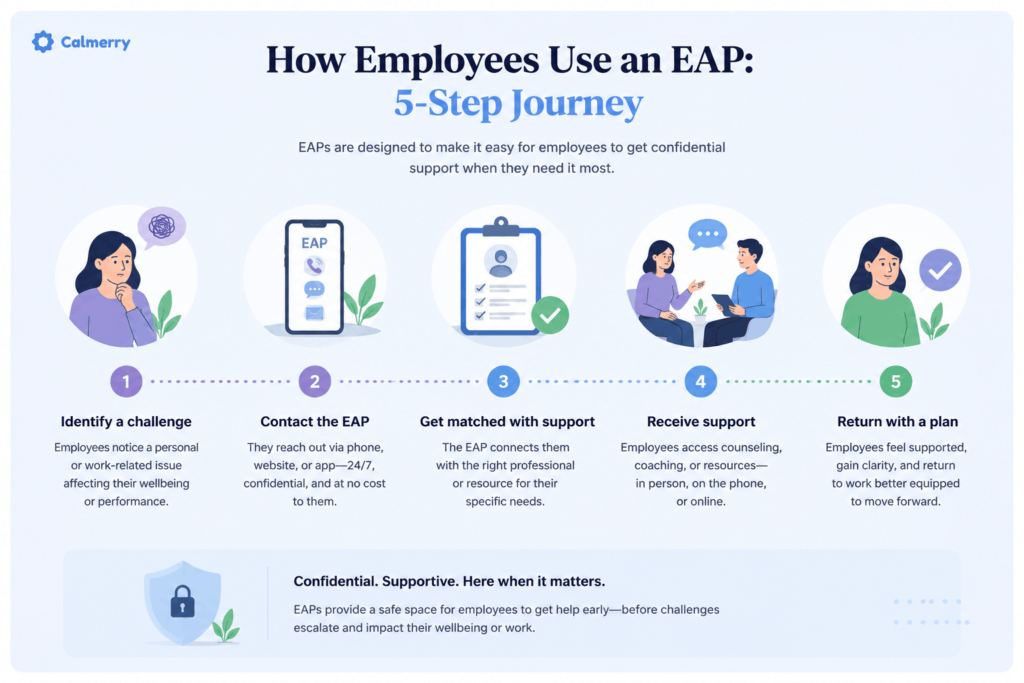
The employee journey through an EAP is typically straightforward, but awareness and communication determine whether employees use the benefit at all.
EAP vs Modern Mental Health Platforms
The comparison between traditional EAPs and modern mental health platforms is not about which is better in absolute terms. It is about which is better suited to a specific workforce, set of goals, and budget.
Traditional Employee Assistance Programs (EAPs)
- Access is usually provided through phone support or in-person referrals.
- Employees typically receive 3–8 counseling sessions per issue.
- Provider selection depends on network availability.
- Personalization options are limited.
- Average engagement rates are relatively low, often around 3–10%.
- Employer reporting is usually minimal.
- Primarily focused on reactive support and crisis intervention.
- Strong 24/7 crisis hotline services are often included.
- Typically costs $15–$35 per employee per year.
- Often operates as a standalone benefit.
- Services are usually delivered by licensed counselors.
Modern Mental Health Platforms
- Accessible through mobile apps, web portals, and on-demand digital services.
- Employees often receive ongoing or subscription-based access to support.
- Therapist matching is powered by algorithms, clinical teams, or both.
- Care plans can be personalized based on employee needs and goals.
- Well-designed platforms often achieve 20–40%+ engagement rates.
- Employers gain access to dashboards, utilization data, and outcome reporting.
- Support extends beyond crisis response to include burnout prevention, resilience training, coaching, and self-care resources.
- Crisis support varies depending on the provider.
- Costs typically range from $60–$1,200 per employee per year, depending on program scope.
- Frequently integrates with HR systems, Slack, Microsoft Teams, Workday, and other workplace tools.
- Clinical depth ranges from self-guided coaching tools to full therapy services.
Modern platforms like Spring Health report engagement rates that are often 10 times higher than the traditional EAP average of 2–5%. That difference in utilization is what drives the gap in measurable outcomes.
Mental Health Benefits Platforms for Employees
Mental health benefits platforms are a newer category of employer-sponsored support. Unlike EAPs, which are primarily reactive and session-limited, these platforms deliver ongoing, personalized mental health support through digital tools, combining therapy access, coaching, self-guided programs, and proactive wellbeing content in a single interface.
Platforms like Calmerry provide employees with direct access to licensed therapists through a structured, subscription-based model. Employer dashboards provide utilization insights, and employees can access support on their own schedule without the friction of a hotline or waiting list. This model tends to generate significantly higher engagement than traditional EAP structures, particularly among younger employees who expect digital-first experiences.
The key distinctions are accessibility, continuity of care, and measurement. Where an EAP provides a limited number of sessions and then refers the employee elsewhere, a mental health platform can support an employee across multiple issues and over an extended period, tracking progress and adjusting the support model accordingly.
How Modern Companies Are Replacing or Expanding EAPs
Most organizations are not making a binary choice between an EAP and a platform. The more common approach is hybrid: keeping the EAP for its crisis hotline and legal/financial referral services, while layering a digital mental health platform on top to address the gaps in access, personalization, and engagement.
“The question is no longer EAP or mental health platform. For many employers, the most effective strategy is combining both.” | Workplace wellbeing strategy insight
This approach makes sense for several reasons. The EAP’s crisis infrastructure is genuinely hard to replicate at low cost. The legal and financial counseling services address stressors that clinical platforms typically do not cover. And the compliance and documentation functions of an EAP have genuine HR value.
What the EAP does not do well is where digital platforms add the most value. Where EAPs have historically fallen short in areas like high wait times, limited session availability, and low engagement in EAP programs, digital workplace mental health solutions have demonstrated stronger performance.
Some larger organizations are replacing their traditional EAP entirely with a modern platform that includes crisis support as a built-in feature. This works best when the platform has strong clinical protocols and 24/7 access, and when the organization has outgrown the basic coverage model of a traditional EAP.
When an EAP Is Still the Right Choice
There are situations where a traditional EAP remains the most practical option.
- Small businesses with limited benefits budgets that need a foundational level of mental health support without the cost or complexity of a full platform
- Organizations with strong compliance requirements that need a documented, clinically governed program with clear legal boundaries
- Companies in crisis response mode, where the immediate need is a reliable 24/7 hotline rather than a proactive wellbeing platform
- Businesses already running an EAP that want to improve it through better communication and manager training before investing in a second system
- Industries with specific referral needs, such as legal, financial, and childcare resources, where EAP-provided services are difficult to replicate through a mental health app
The EAP is not obsolete. It is, in many cases, undercommunicated and under-supported, not structurally unsuited to the job.
How to Choose Between an EAP and an Online Therapy for Employees
Use this checklist to guide the decision:
Company size and structure
- Do you have fewer than 100 employees? A basic EAP may be sufficient as a starting point.
- Do you have a distributed or remote workforce that needs digital-first access?
- Are employees asking for more mental health support than the current EAP provides?
Budget
- Can the organization afford a per-employee cost of more than $35/year for enhanced support?
- Is there a budget to run both an EAP and a supplemental platform?
- What is the estimated cost of reduced absenteeism workplace and turnover, and could better mental health support reduce it?
Employee needs
- Is the current EAP underutilized despite strong communication efforts?
- Are employees asking for ongoing therapy access rather than short-term counseling?
- Is burnout prevention or resilience building a stated HR priority?
Goals and measurement
- Does the current solution provide employer-facing analytics and outcome data?
- Is demonstrating ROI to leadership a requirement?
- Are there specific engagement targets the current EAP is not meeting?
Cost of EAP vs Mental Health Platforms
Basic EAP
- Approximate cost: $15–$35 per employee per year
- Includes: short-term counseling services, crisis hotline access, and legal or financial referrals.
- Best for: organizations seeking affordable foundational mental health support.
Enhanced EAP
- Approximate cost: $35–$80 per employee per year
- Includes: traditional EAP services plus digital access, additional counseling sessions, and limited coaching support.
- Best for: companies looking to improve utilization without significantly increasing costs.
Mental Health Apps
- Approximate cost: $60–$240 per employee per year
- Includes: mindfulness tools, self-guided programs, stress management resources, and, in some cases, coaching access.
- Best for: organizations focused on scalable support for large or distributed teams.
Comprehensive Therapy Platforms
- Approximate cost: $400–$1,200 per employee per year
- Includes: therapy sessions, coaching, personalized care plans, and employer analytics.
- Best for: employers prioritizing clinical outcomes and comprehensive mental health support.
Hybrid EAP + Mental Health Platform
- Approximate cost: $100–$500 per employee per year
- Includes: traditional EAP benefits combined with digital mental health tools and expanded access to care.
- Best for: organizations seeking a balance between affordability and employee engagement.
The cost comparison should always be weighed against utilization. An EAP at $25 per employee per year with 5% utilization delivers a narrower real-world impact than a platform at $300 per employee with 35% utilization. The cost per engaged employee is a more honest metric.
Common Mistakes Employers Make with EAPs
- Launching and forgetting. EAPs that are introduced at benefits enrollment and never mentioned again generate minimal utilization. Regular, multi-channel communication is essential year-round.
- Assuming employees know how to access support. Most do not. Clear, simple instructions (e.g., how to call, what to expect, what is confidential) need to be communicated proactively.
- Skipping manager training. Managers are the most influential referral source for mental health support. If they do not know what the EAP covers or how to recommend it sensitively, utilization stays low.
- Not measuring anything. 31% of UK companies have never evaluated the quality or impact of their EAP. Without measurement, there is no basis for improvement or investment decisions.
- Treating the EAP as the complete solution. For organizations with meaningful mental health challenges in their workforce, an EAP alone is rarely enough. It is a starting point, not a strategy.
- Ignoring stigma. The EAP model requires employees to self-identify a problem and make a call. Reducing stigma through leadership behavior, open communication, and a supportive manager culture is what makes employees willing to take that step.
FAQs
1. What is an employee assistance program (EAP)?
An EAP is an employer-funded benefit providing confidential, short-term support for employees dealing with personal or work-related challenges. Services typically include mental health counseling, crisis support, legal referrals, and financial guidance.
2. How EAP works?
Employees contact the EAP provider, usually by phone, app, or web portal, to request support. They are connected to a licensed professional and can receive a set number of counseling sessions. All interactions are confidential; the employer does not receive individual-level data.
3. What services are included in an EAP?
Core services include short-term counseling, 24/7 crisis support, legal and financial referrals, and work-life resources. The scope varies by provider and contract.
4. What are the benefits of an employee assistance program?
EAPs provide accessible, low-cost mental health support that reduces absenteeism, supports employees in crisis, and gives organizations a documented wellbeing benefit. The American Psychological Association notes that access to mental health support is consistently linked to improved productivity and workplace functioning.
5. What are the limitations of EAPs?
Low utilization, limited session numbers, reactive design, minimal personalization, and poor employer-facing analytics are the most common limitations. The National Institute of Mental Health emphasizes that untreated mental health conditions generate significant workforce costs — a challenge that session-capped EAPs often cannot fully address.
6. What is the difference between an EAP and a mental health platform?
EAPs provide short-term, reactive support through a referral model. Mental health platforms offer ongoing, personalized access to therapy and coaching through digital tools, with higher engagement rates and better employer analytics.
7. Are EAPs still effective in 2026?
Yes, when properly implemented and communicated. The World Health Organization and the Centers for Disease Control and Prevention both recognize structured employee support programs as effective components of workplace mental health strategy. The challenge is not effectiveness in principle — it is closing the utilization gap in practice.
8. What are alternatives to employee assistance programs?
Modern EAP alternatives include comprehensive mental health platforms like Lyra Health, Spring Health, and Modern Health, as well as therapy-focused services like Calmerry that provide employees with direct access to licensed therapists on demand. Many organizations run a hybrid model, keeping the EAP for crisis and referral services while adding a platform for ongoing mental health support. The Harvard Business Review has consistently highlighted that proactive, accessible mental health support generates stronger business outcomes than reactive models alone.