Low-Stress Jobs for Anxiety Sufferers


In this article
The alarm clock isn’t just a sound. It’s a threat. It’s a jagged, violent interruption that signals the start of another battle. For those who experience anxiety, waking up it’s the opening bell of a boxing match against your own nervous system. You stare at the ceiling, and your heart is already doing a heavy metal drum solo against your ribs.
This isn’t just “disliking your job.” This is the visceral, electrified hum of anxiety in the workplace, a beast that feeds on a high-pressure work environment, open-plan offices, and the incessant ping of Slack notifications. If you have a diagnosed anxiety disorder, the stakes feel impossibly high.
We are constantly told to grit our teeth, to lean in, to hustle. But what if the problem isn’t the texture of your soul, but the soil you are planted in?
You wouldn’t blame a cactus for rotting in a rainforest, yet we blame ourselves for crumbling under the fluorescent glare of a sales floor. It’s time to stop trying to retrofit your nervous system to tolerate an adrenalized nightmare. It’s time to look for jobs for people with anxiety that don’t demand a pound of flesh every Monday morning.
What Makes a Job Anxiety-Friendly?

So, what does safety look like on a payroll? It’s rarely about the money. It’s about the noise floor. When we ask what makes a job low-stress, we are really asking about predictability.
Low stress jobs share specific DNA markers. The anxious brain is an imagination machine, constantly spinning catastrophic scenarios. A job often becomes a source of trauma because the variables are wild. Jobs that offer consistency, where A always leads to B, act as a soothing balm. We aren’t looking for “easy.” We are looking for “known.”
Then there is the social battery. Jobs for people with anxiety usually prioritize depth over breadth. High-stress jobs often force you into constant social performance, juggling fifty shallow interactions with strangers. In contrast, careers for anxious people often focus on solitary tasks.
If you are someone with social anxiety (or social anxiety disorder), you likely prefer minimal social interaction, not because you hate people, but because the levels of stress involved in forced small talk are exhausting.
People with social anxiety need options for people who require autonomy. You need an employer who understands that silence does not equal inactivity.
Finding a role with minimal social interaction allows you to control your workflow, to step away when the panic rises, and to be judged on your output rather than your “face time.” You want a friendly environment where the work sits on the desk, not on your shoulders, when you clock out.
Remote and Work-From-Home Solutions
The pajama revolution changed everything.
For years, the office was the only option, but the rise of remote work has been a mass exhaling for introverts everywhere. Your home is your fortress. You control the lights. You control the temperature. Virtual roles allow you to strip away the performative aspects of labor.
Jobs that allow you to work remotely act as a buffer. You don’t have to “look busy.” You just have to be productive. This job that fits your lifestyle eliminates the commute, that harrowing hour of traffic that drains your battery before the day even begins.
Many jobs in the tech and admin sectors have gone fully digital, offering paying jobs without the stress of the cubicle farm.
However, be careful. Jobs offer freedom, but virtual isolation can sometimes let the thoughts echo too loudly. Success here means building a rigorous structure to maintain work-life balance and keep the sanctuary sacred.
Top Low-Stress Job Categories and Specific Roles
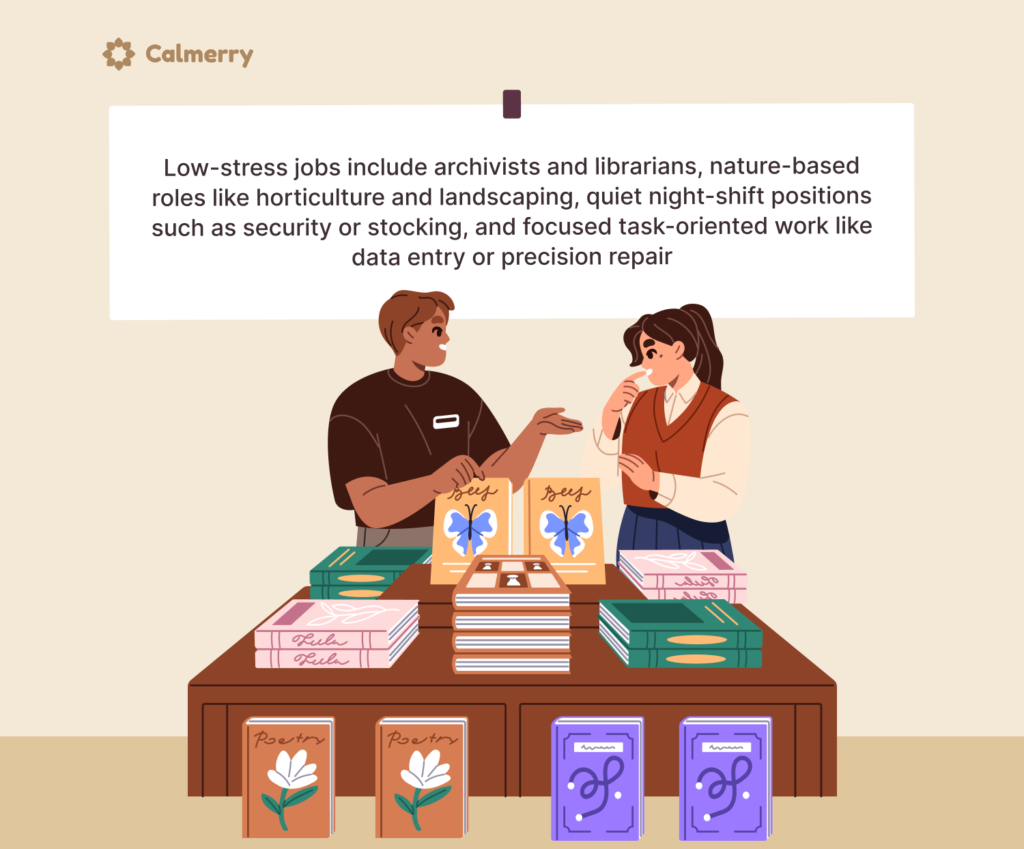
Where do we actually look? What does a sustainable career path look like? You might have searched for a list of 30 jobs that promise nirvana, or the top 10 low-stress jobs. Let’s cut through the noise and look at types of jobs that actually work.
Consider the dust. The quiet, settled, aromatic dust of an archive. Working as an archivist or a librarian is a communion with order. There is something profoundly soothing about taxonomy. People with anxiety include those who find peace in knowing that “A” comes before “B” when the rest of life feels like a scrambled alphabet soup.
The Bureau of Labor Statistics notes that these relatively low-stress roles prioritize independent work, making them some of the best jobs for people. [1] Home. (2025, August 28). Bureau of Labor Statistics. https://www.bls.gov/ooh/
Maybe you need to touch the earth. Horticulture, landscaping, or park ranging. Jobs that involve nature are biologically grounding. Plants don’t send passive-aggressive emails; they just grow. It’s binary and honest.
Jobs may require hard labor, but when you are elbow-deep in soil, the chatter in your brain tends to quiet down. These are essentially free jobs, free of the corporate politics that plague high-stress environments.
Then there are the kings of the empty hallway. The night shift. Security guard, commercial cleaner, stocker. Dealing with people is kept to a minimum. You are the sovereign of the silence.
It is a form of meditative solitary confinement where you can finally hear yourself think. While not always jobs that pay well immediately, they offer limited social interaction and a steady rhythm.
But what if you need jobs that pay a mortgage? Look at jobs that may help you enter a flow state. Data entry. Precision trades like watch repair. Options for people who need to manage stress often lie in tasks that demand laser focus.
Anxiety may tell you that you can’t handle pressure, but you can handle focus. The best low stress jobs are those where the task is a puzzle to be solved, tangibly, with your hands or your mind, with minimal social pressure.
There is no definitive list of 10 low stress jobs that work for everyone, but looking for roles with clear boundaries is the key.
Managing Your Current Job While Dealing with Anxiety
Maybe you can’t quit today. You have bills. You have to survive the current battlefield. Managing anxiety at work starts with aggressive boundary setting.
Dealing with anxiety in a high-octane work environment requires you to train your “no” muscle. Your employer might push for 24/7 availability, but it means not checking email after 6 PM. It means wearing noise-canceling headphones. If you want to reduce stress, you have to create micro-sanctuaries. The bathroom stall. The stairwell. 5 minutes of deep breathing can reset your stress levels.
To manage your anxiety, you must detach your self-worth from your productivity. Workplace stress feeds on the idea that you are only as good as your last report. That is a lie; if you are looking to find a job that fits better, or just look for jobs casually, keep searching, but in the meantime, treat your current role as a transaction, not an identity.
How Online Therapy Transforms Your Work Life
This is where the real change happens. You can switch to lower stress roles, but if you don’t change your internal wiring, the panic will eventually find you in the quietest library on earth. Anxiety impacts every facet of your perception.
Anxiety treatment through platforms like Calmerry is a strategic dismantling of the fear response. When we talk about people with anxiety disorders facing career change anxiety, we are talking about cognitive distortions. Your brain is lying to you. It tells you that if you make a mistake, your employer will fire you.
Therapy helps you reduce anxiety by putting a stick in the spokes of that bicycle. It helps the sufferer become the operator. Jobs that offer mental health benefits are great, but independent therapy is often necessary to truly manage stress.
Whether you face anxiety or social anxiety, a therapist acts as a co-pilot on your career path. They help you realize that you are capable of more than just enduring.
Taking Action – Your Next Steps
The heavy metal drum solo in your chest doesn’t have to be the soundtrack of your life.
You have options. You can look for the quiet corners, the archives, the gardens. You can look for the best jobs for people with anxiety. But you don’t have to do it alone.
Home. (2025, August 28). Bureau of Labor Statistics. https://www.bls.gov/ooh/

online therapy
live video session