Parenting with Anxiety


In this article
Parenting always involves an invisible weight that never gets switched off. This is the 3 am worry loops, the state of hypervigilance, or feeling “on edge” are all about, even when everything is otherwise in order. This is what many parents are coping with on a day-to-day basis: anxious, with stress held in their bodies while striving to be present for their children.
Although it is normal for parents to feel stressed, it is essential to distinguish between caring for a kid and being anxious about their care. When mothers or caregivers feel anxious for too long, it interferes with their parenting behavior, affecting their reactions to their children, which could mean that they have an anxiety disorder. Moreover, around 31.1% of adults experience an anxiety disorder in their lifetime. [1] Any anxiety disorder. (n.d.). National Institute of Mental Health (NIMH). https://www.nimh.nih.gov/health/statistics/any-anxiety-disorder
Being anxious does not make you a bad parent. You are not striving for perfection here. You are trying to figure out ways to manage your own anxiety issues without causing a transmission of anxiety to children. Having the right resources, such as online therapy for anxiety, such as Calmerry, can help you achieve that.
Signs of the “Anxious Parent” Trap
Anxiety in parents can often be subtle. It is evident in their constant alertness, such that normal situations seem like threats. Their nervous systems do not get a chance to relax after experiencing stress. This keeps anxious parents tense for prolonged periods. Such behaviors are evident in anxious caregivers and are also related to stress and mental issues.
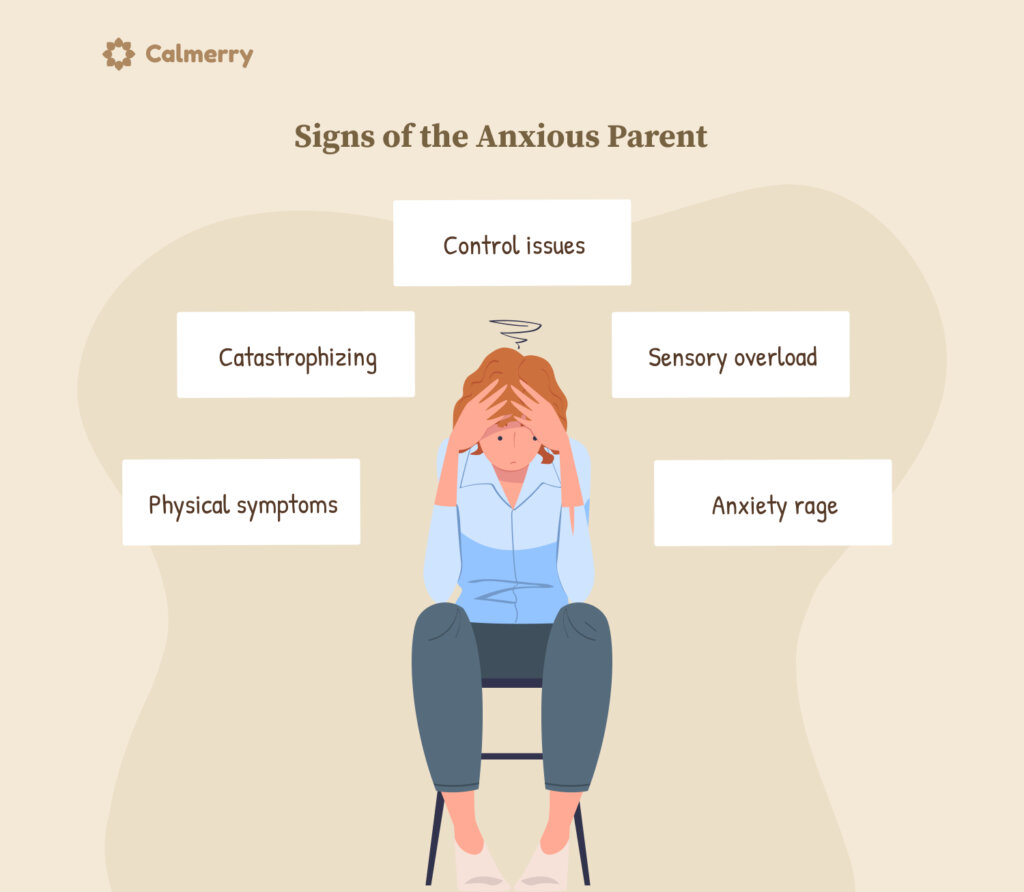
Signs of the anxious parent trap may include:
- Sensory overload: Feeling “touched out,” overwhelmed by noise, mess, or requests. Regular noises become too much to tolerate, especially after a long day.
- Anxiety rage: Outbursts or yelling because of feelings of being overwhelmed, not anger. This is frequently the aftermath of stressful periods, unrelated to a lack of love or patience.
- Catastrophizing: Jumping to worst-case scenarios for small things that happen. “My child failed a quiz” can become a concern about falling behind or blowing my child-raising career. This pattern is often observed in people with anxiety disorders.
- Physical symptoms: Feeling a rapid heart rate, fatigue, muscle aches, headaches, or insomnia, even if the child is actually asleep.
- Control issues: Being unable to let other people help with childcare. Their own help is what prevents some children from being hurt by strangers.
These feelings are not personal issues. These feelings indicate the influence of anxiety on the body and mind. A national survey showed that 66% of parents feel isolated, and 62% feel burnt out by their parental roles. [2] Study: Pressure to be “perfect” causing burnout for parents, mental health concerns for their children. (n.d.). The Ohio State University Wexner Medical Center. https://wexnermedical.osu.edu/mediaroom/pressreleaselisting/study-pressure-to-be-perfect-causing-burnout-for-parents-mental-health-concerns-for-their-children This is evidence of the pervasiveness of the issue.
Anxiety can influence children’s emotional security. It can increase the risk of children developing anxiety disorders. Recognition of such signs leads to relief, support, or improved strategies for both mothers and children.
The Ripple Effect: Mirroring and Repair
Children learn to regulate their emotions through the practice of co-regulation. They learn emotional cues from the adults they live with. If a parent is emotionally regulated, children feel more secure. Conversely, if the emotionally stressed parent is the caregiver, the child could become clingy, have temper tantrums, or become defiant.
This is not to say that parents trigger anxieties deliberately. Rather, parental anxieties correlate strongly with the child’s anxiety, especially in young kids. Anxious children look to their caregivers to determine whether the environment is emotionally safe, and ongoing stress can contribute to passing anxiety from parent to child over time.
It is important to repair, not avoid, mistakes. All parents get frustrated. Repairing means stepping back in time to the point of what happened, apologizing, and then explaining things. Such instances teach children that feelings can be controlled for their own protection and that their relations with others can be fixed after times of anxiety.
Research confirms this; when mothers or fathers experience more anxiety, children tend to experience more anxiety too, especially younger children and girls. [3] Shek, D. T. L., Li, X., Yang, B., & Yang, J. (2025). Is parental anxiety related to child anxiety? Insights from a four-wave longitudinal study in a Chinese context. Frontiers in Psychiatry, 16, 1570652. https://doi.org/10.3389/fpsyt.2025.1570652 This is one of the ways that children are so affected by their parents’ emotional levels.
Awareness is the best course of action. When children understand that their own mothers or other caregivers are struggling with anxiety issues, there is a reduced risk of children developing the same issues. Acknowledging the presence of anxiety rather than denying it makes children feel more protected.
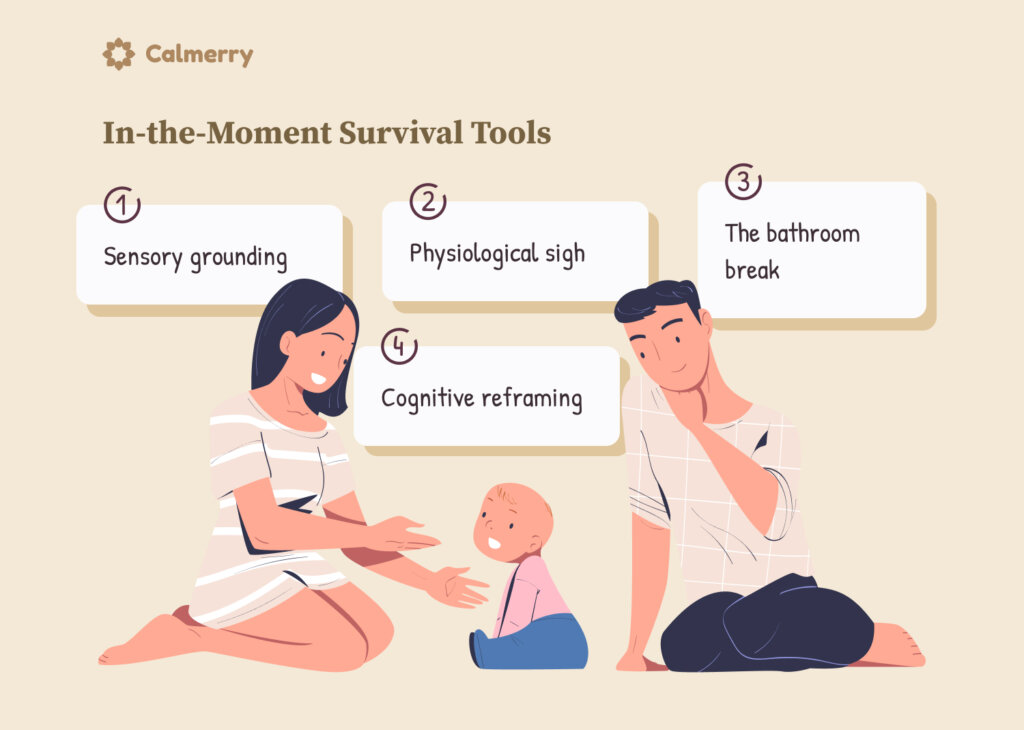
In-the-Moment Survival Tools
When anxiety takes over, it can feel overwhelming. There is a lot going on: noise, feelings, stress, and responsibility. During these periods, the mind is fixated on danger rather than reason.
Anxiety-management techniques are designed to work in the moment to break this cycle of anxiety. These techniques produce a state of calm that works to safeguard your psychological health and relationship with your child.
Sensory Grounding
When you feel anxious, your attention becomes narrowed, and your body is put into a state of alert. Sensory grounding helps expand your attention and anchor you in the present moment. Here is what you need to do:
- List 5 things that you can see.
- Find 4 things that you can feel.
- Listen for 3 things that you can hear.
- Identify 2 things that you can smell.
- Taste one thing.
This can break a panic cycle, and it assures your nervous system that you are safe by quickly alleviating your anxious feelings.
The Bathroom Break (60 seconds)
A brief pause before responding can feel very awkward for anxious parents, but it is actually a means of self-emotional regulation, not avoidance. Pausing before responding is an effective practice for improving your relationship with your child.
You can say, “Please let me have one minute.” Then go into another room or even the bathroom. Breathe a few times before you return.
That pause helps in reducing reactivity as it prevents the child from exhibiting anxious behaviors.
Physiological Sigh
Anxiety is as much a bodily experience as it is an intellectual one. Breathing exercises calm the nervous system by dealing directly with the issue, without having to “think your way out” of it.
Breathe in through the nose for 4 seconds. Hold for 7 seconds. Slow exhale through the mouth for 8 seconds.
Exhalations that are prolonged and gradual activate the vagus nerve, which assists in getting the body out of the fight-or-flight response.
Cognitive Reframing
Anxious thoughts tend to escalate a situation more quickly than what is actually happening. Reframing helps to regain perspective without denying that things are not easy at the moment.
Replace “This is a disaster” with “This is uncomfortable, but not dangerous.”
This helps with the management of anxiety, prevents catastrophizing, and ensures that you remain emotionally engaged with your child.
Regular use of such techniques could reduce the levels of stress that could contribute to anxiety pertinent to your everyday child-rearing practices.
Micro-Self-Care & Lifestyle Adjustments
For anxious parents, advice on self-care practices can appear pointless or even anxiety-causing. Complete breaks, spa sessions, or ideal routines would be difficult to implement.
These practices of self-care can actually enhance feelings of guilt for anxious parents. It is important for anxious parents to prioritize small practices that support the body and their nervous systems. These small methods can help anxious parents manage additional levels of stress that occur due to their anxious state.
These are related to biological maintenance rather than indulgence. They work to stabilize levels of anxiety, ensure good mental health, and prevent anxiety from impacting parental behaviors.
Radical acceptance
During periods of great stress, you must deliberately lower your standards. This could mean eating simpler fare, not cleaning spotlessly, or postponing some tasks. You must learn to accept that not everything can or should be accomplished to the best of your ability. This is one way to reduce the stresses that contribute to anxiety. A more relaxed and flexible setting is also better for children who are sensitive to emotional change.
Movement
Brief periods of physical movement, such as walking or stretching, can help the body release cortisol. You do not need to do formal exercise. Even 10 minutes can help with anxiety, mood issues, and responding to parental challenges.
Sleep hygiene
Anxiety also interferes with sleep, especially for mothers who remain awake even after their child is asleep. Concentrate on establishing bedtime routines, cutting screens before bedtime, and resting without expecting to “sleep perfectly.” A better rest schedule helps manage emotional issues related to anxiety.
Being mindful while moving
Mindfulness does not require quiet or stillness. Engaging with presence while washing dishes, folding laundry, or accompanying your child on a walk helps anchor you in the present. This decreases mind-wandering while ensuring that you remain firmly grounded when faced with difficult situations.
Such small lifestyle modifications increase the ability to resist adversity. Gradually, such practices enhance positive parental interactions with the child and minimize the chances of anxiety being transmitted unintentionally in the family.
Online Therapy and Professional Support
Many parents face challenges that may make seeking professional help seem like a daunting prospect. This is not necessarily because support is not needed, but because time, effort, and logistics can be difficult to reconcile. Online therapy takes care of such challenges, allowing easier accessibility for many parents who are dealing with daily stress, work, and child-rearing.
Calmerry is a good option for busy parents with anxiety disorders who need easily accessible professional help. The platform offers parents access to licensed therapists who specialize in issues such as anxiety, family relationships, and parent-child relationships. These online sessions are private, flexible, and convenient enough to ensure consistency with care, even with parental responsibilities.
Besides the therapy, there are other resources that some parents with anxiety use for daily regulation purposes:
Insight Timer: It is a free application that offers various meditations, breathing techniques, and strategies to overcome anxiety that can easily be incorporated into one’s daily routine.
NAMI (National Alliance on Mental Illness): Provides information, support group services, as well as other resources for parental concerns related to anxiety disorders or other related mental issues.
Getting professional help is no indicator of failure, but a precautionary measure. When parents look after their own psychological issues, it helps reduce the risk of children developing any sort of anxiety disorders, not to mention creating a stable setting for the entire family.
How to Parent Effectively When You Live With Anxiety
Anxiety is something that can be managed, but there is no such thing as perfect parenting. The key is having some awareness, flexibility, and learning to manage one’s own anxiety in more effective ways. When this is achieved, it helps reduce the influence of anxiety on parental behavior.
When you manage your emotions, you role-model good emotional intelligence for your child. This is important for children who feel safe enough to manage their own emotions. You don’t have to let anxiety be what defines your family or your child’s life.
Start small. Find one tool from this article that you can practice today. If you or your child is struggling with anxiety, it is supportive to seek the help of other professionals, too.
Any anxiety disorder. (n.d.). National Institute of Mental Health (NIMH). https://www.nimh.nih.gov/health/statistics/any-anxiety-disorder
Study: Pressure to be “perfect” causing burnout for parents, mental health concerns for their children. (n.d.). The Ohio State University Wexner Medical Center. https://wexnermedical.osu.edu/mediaroom/pressreleaselisting/study-pressure-to-be-perfect-causing-burnout-for-parents-mental-health-concerns-for-their-children
Shek, D. T. L., Li, X., Yang, B., & Yang, J. (2025). Is parental anxiety related to child anxiety? Insights from a four-wave longitudinal study in a Chinese context. Frontiers in Psychiatry, 16, 1570652. https://doi.org/10.3389/fpsyt.2025.1570652

online therapy
live video session