Best Mental Health Platforms for Companies: Comparison and Selection Guide



In this article
Picking mental health benefits platforms for employees used to mean choosing between an EAP and a meditation app. The market looks very different now. There are dozens of platforms covering everything from clinical therapy and AI-driven provider matching to coaching, financial wellness, and burnout prevention, and the differences between them matter enormously for utilization, outcomes, and cost.
The challenge is not a shortage of options. It is figuring out which type of solution fits the specific workforce, the available budget, and the goals HR leadership is trying to hit. A platform designed for a 5,000-person enterprise will not serve a 150-person startup well, and the reverse is equally true. Getting this decision wrong means paying for something employees do not use — a pattern that is more common than most HR teams would admit.
This guide breaks down the categories, compares the leading platforms, and gives employers a practical framework for making the right choice.
Why Companies Are Investing in Mental Health Platforms
The business case has become difficult to ignore. 62% of employees globally are disengaged, generating a productivity loss of $8.8 trillion annually according to Gallup, and disengagement is directly linked to untreated mental health strain. The American Psychological Association consistently documents the connection between psychological well-being and workplace performance. The World Health Organization estimates that depression and anxiety cost the global economy $1 trillion per year in lost productivity.
The response from employers has been significant. 91% of employers planned to increase investment in mental health apps and platforms in 2024, and 66% planned to increase investment in stress management and resilience tools. The shift is structural, not cyclical. Mental health platforms have moved from a supplemental perk to a core component of how companies manage workforce health and performance.
“Mental health support is no longer viewed as an employee perk—it has become part of workforce infrastructure.” | Workplace mental health insight
What has changed is not just the awareness — it is the availability of solutions that actually generate measurable engagement and outcomes. Traditional EAPs with 3–5% utilization are giving way to digital platforms reporting engagement rates of 20–40% or higher.
What Makes a Great Mental Health Platform for Employees
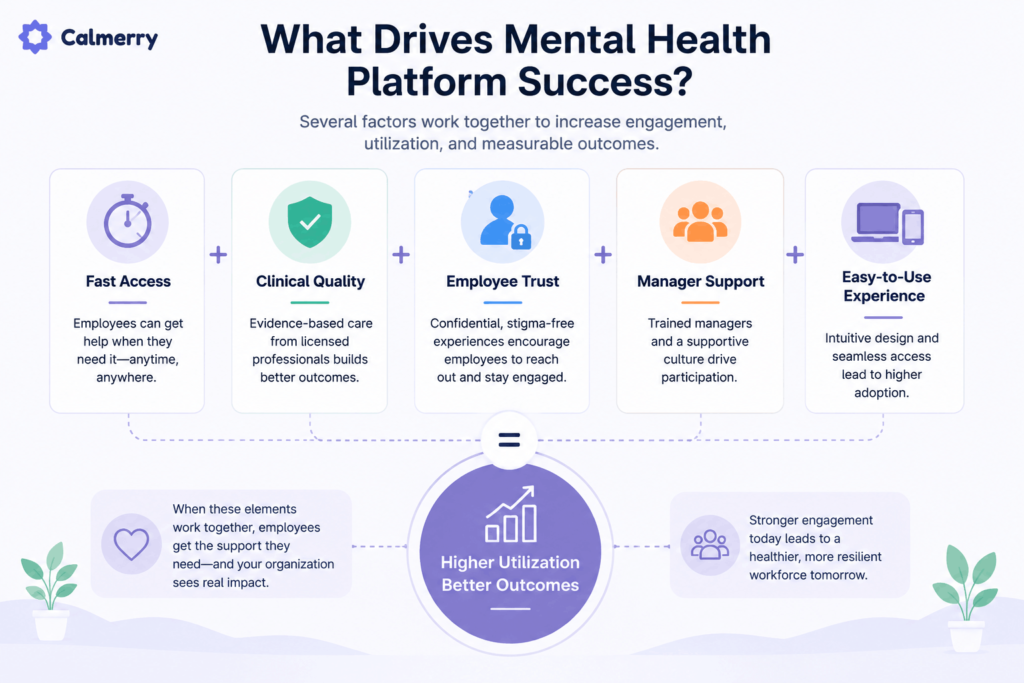
Before comparing specific platforms, it helps to understand what the strongest solutions have in common. The following criteria separate platforms that generate real outcomes from those that look good on a benefits page and go unused.
- Accessibility — Available on mobile, web, and across time zones. Low-friction access means employees can reach support without scheduling delays or complex enrollment steps.
- Clinical quality — Providers are licensed, evidence-based treatments are used, and the platform has measurable outcome data to show it works.
- Personalization — Support adapts to the employee’s specific situation rather than offering a generic menu of resources.
- Engagement rate — What percentage of eligible employees actually use the platform? This is the most honest measure of whether a product works in practice.
- Scalability — The solution works for the company at its current size and its projected size 18 months from now.
- Employer analytics — HR teams can see utilization data, engagement trends, and outcome reporting without accessing individual employee records.
- Integration — The platform connects to existing HR systems like Workday, BambooHR, or Slack, rather than operating as a standalone tool that employees must remember to visit.
- Speed of access — How quickly can an employee connect with a therapist or counselor after requesting support? Wait times of weeks undermine the value of any platform.
- Stigma reduction — The access model and interface should feel welcoming rather than clinical. Employees who feel judged will not engage.
Best Mental Health Platforms for Companies in 2026
The platforms below represent different categories and use cases. No single solution is right for every organization. The right choice depends on company size, workforce needs, budget, and whether clinical therapy or broader wellbeing support is the primary goal.
Clinical therapy platforms (highest depth of care):
- Spring Health — AI-driven provider matching with a Care Navigator for each employee; strong clinical outcomes data; best for mid-to-large employers prioritizing clinical accuracy
- Lyra Health — Evidence-based therapy with a curated provider network; suitable for enterprise organizations with clinical-first priorities
- Modern Health — Full-spectrum model combining therapy, coaching, and digital wellness; strong for global teams needing consistent cross-border coverage
Therapy and coaching hybrid platforms:
- Headspace for Work — Mindfulness, meditation, and sleep tools; good for stress prevention and culture building; lower clinical depth
- Talkspace for Business — Text, audio, and video therapy access; flexible pricing; accessible for smaller teams and remote workforces
- Calmerry — Licensed therapist access with flexible session scheduling and employer reporting; strong fit for companies needing clinical quality without enterprise pricing
Holistic employee wellbeing platforms (broader than mental health alone):
- Personify Health — Combines mental, physical, financial, and social wellbeing; includes health plan administration; built for large complex organizations
- Wellness360 — Eight-pillar wellness framework with employer analytics and team challenges
- Wellable — Flexible content library covering physical activity, nutrition, mindfulness, and financial health
Engagement-focused tools:
- YuMuuv — Team-based wellness challenges and activity tracking; high participation rates; best as a complement to clinical support
- BetterUp — Leadership and professional coaching; strong for manager development and resilience
Comparison of Top Mental Health Platforms
While all mental health platforms aim to improve employee well-being, they differ significantly in clinical depth, accessibility, reporting capabilities, and ideal use cases. The comparison below highlights where each solution is strongest.
Clinical Therapy Platforms
Spring Health
- Best for: Mid-to-large employers with a clinical focus
- Core offering: Clinical therapy with Care Navigator support
- Session model: Subscription-based
- Employer analytics: Strong
Lyra Health
- Best for: Enterprise organizations prioritizing clinical care
- Core offering: Evidence-based therapy through a curated provider network
- Session model: Subscription-based
- Employer analytics: Moderate, with HIPAA-related limitations
Modern Health
- Best for: Global teams seeking comprehensive support
- Core offering: Therapy, coaching, and digital wellness tools
- Session model: Subscription-based
- Employer analytics: Strong
Calmerry
- Best for: Small and mid-sized businesses looking for affordable clinical support
- Core offering: Licensed therapist access with flexible scheduling
- Session model: Session-based or subscription options
- Employer analytics: Available
Talkspace Business
- Best for: Remote and distributed teams
- Core offering: Text, audio, and video therapy access
- Session model: Subscription or per-session pricing
- Employer analytics: Moderate
Well-Being and Prevention Platforms
Headspace for Work
- Best for: Stress prevention and workplace well-being culture
- Core offering: Mindfulness, meditation, and sleep support
- Session model: Subscription-based
- Employer analytics: Basic
Personify Health
- Best for: Large enterprises seeking full-spectrum well-being support
- Core offering: Mental, physical, financial, and social well-being plus health administration
- Session model: Subscription-based
- Employer analytics: Strong
Wellable
- Best for: Mid-sized organizations seeking a holistic well-being solution
- Core offering: Wellness content covering physical, mental, and financial health
- Session model: Subscription-based
- Employer analytics: Moderate
Coaching and Leadership Development
BetterUp
- Best for: Leadership development and resilience building
- Core offering: Professional coaching and leadership support
- Session model: Subscription-based
- Employer analytics: Strong
Key Takeaway
The right platform depends on the primary goal. Organizations seeking clinical therapy access typically focus on solutions such as Spring Health, Lyra Health, Modern Health, Calmerry, or Talkspace Business. Companies prioritizing prevention, engagement, and broader well-being initiatives often look at Headspace for Work, Wellable, or Personify Health. Leadership-focused organizations frequently complement these solutions with coaching platforms such as BetterUp.
Corporate Mental Health Programs vs Platforms
These two terms describe different things, and the distinction matters for procurement decisions.
Corporate mental health programs are structured initiatives: manager training, wellness challenges, peer support networks, and company-wide awareness campaigns. They are employer-designed and internally run, sometimes supported by outside consultants.
Employee mental health solutions delivered through platforms are vendor-operated tools that give employees direct access to licensed professionals, digital content, or both. The employer funds access. The platform delivers the service.
The most effective approach combines both. A mental health platform provides the access infrastructure. The best employee wellbeing programs build a culture that makes employees willing to use them. Neither works well in isolation.
“Technology provides access. Workplace culture determines whether employees actually use it.” | HR strategy insight
Understanding the category helps narrow the shortlist before doing detailed vendor comparisons.
Therapy platforms connect employees with licensed therapists through video or text sessions. They offer the highest clinical depth and are most appropriate for employees with moderate to severe mental health needs. Examples: Lyra Health, Spring Health, Calmerry, Talkspace.
EAPs (Employee Assistance Programs) provide short-term counseling, crisis support, and referral services at low per-employee cost. Best for organizations that need baseline coverage and compliance support, but typically limited by low engagement rates and session caps.
Wellbeing apps offer self-guided content — meditation, mindfulness, sleep improvement, stress management. Low cost, high accessibility, but no clinical care. Best as a complement to therapy access, not a replacement for it. Examples: Headspace, Calm Business.
Coaching platforms connect employees with professional coaches for career development, leadership growth, and resilience. Not clinical therapy, but valuable for manager development and burnout prevention. Example: BetterUp.
Hybrid solutions combine clinical therapy, coaching, digital self-guided tools, and employer analytics in a single platform. Best for organizations that want comprehensive coverage without managing multiple vendors. Examples: Modern Health, Personify Health.
How to Choose the Right Mental Health Platform
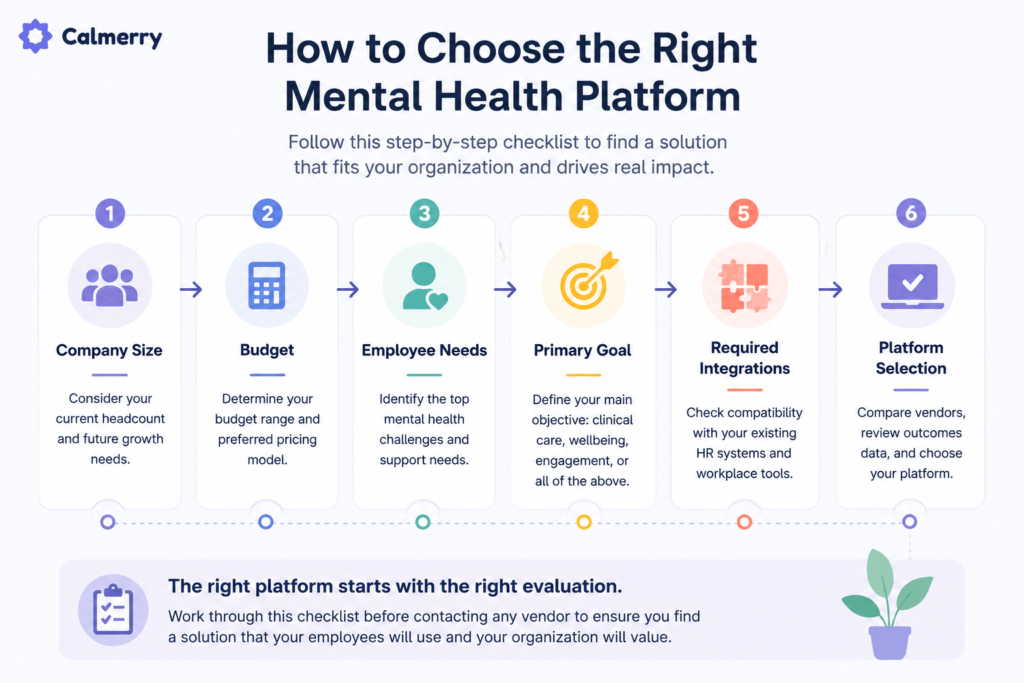
Work through this checklist before contacting any vendor.
Company size
- Do you have fewer than 200 employees? Look for usage-based pricing or session-based models — enterprise subscriptions will be expensive and underutilized at a small scale.
- Do you have 200–1,000 employees? Most mid-tier platforms scale well here.
- Do you have 1,000+ employees? Enterprise platforms with strong analytics and integration become cost-effective at this size.
Budget
- What is the maximum annual per-employee budget for mental health support?
- Is the priority lowest upfront cost or highest utilization and outcomes?
- Can the program be expanded if it demonstrates ROI?
Employee needs
- Has a needs assessment been run to identify the primary mental health challenges in the workforce?
- Do employees primarily need clinical therapy access, or stress prevention and coaching?
- Is the workforce remote, hybrid, or in-person, and how does that affect access model requirements?
Goals
- Is the primary goal reducing absenteeism, improving retention, lowering healthcare costs, or building a wellbeing culture?
- Does the platform provide outcome data that maps to those goals?
- Is there a specific engagement rate target that the platform should be able to demonstrate achieving?
Integration and logistics
- Does the platform connect to existing HR systems?
- Is multilingual support needed?
- What is the implementation timeline, and what does internal management require?
Mental Health Platforms for Small vs Large Companies
The ideal mental health platform depends heavily on company size. Small businesses typically prioritize affordability and ease of implementation, while large enterprises focus on scalability, analytics, and clinical depth.
Small Businesses (Under 200 Employees)
Smaller organizations often benefit from solutions that are easy to launch and flexible in pricing.
Typical priorities
- Cost efficiency
- Fast implementation
- Minimal administrative burden
- Mobile-first employee access
Recommended solutions
- Platforms combined with a basic EAP
- Session-based or usage-based pricing models
- Self-directed employee access with minimal onboarding
Examples
- Calmerry
- Talkspace Business
- Headspace for Work
Large Enterprises (1,000+ Employees)
Enterprise organizations typically require more sophisticated infrastructure and reporting capabilities.
Typical priorities
- Clinical depth and provider quality
- Global coverage
- Integration with HR and benefits systems
- Advanced reporting and outcome measurement
Recommended solutions
- Full-spectrum wellbeing platforms
- Best-of-breed vendor combinations
- Per-employee subscription models
Examples
- Lyra Health
- Spring Health
- Modern Health
Company size should influence platform selection. A solution that delivers strong value for a 100-person company may be inefficient or insufficient for a workforce of 10,000 employees.
Smaller organizations often benefit most from platforms that charge per session or per active user rather than per covered employee. Paying for access that most employees never use is the dominant cost problem at smaller headcounts.
For enterprise organizations, the priority shifts to clinical quality, provider network size, integration with benefits administration systems, and the ability to generate aggregate reporting that informs HR strategy. Platforms like Calmerry bridge this gap well, offering online therapy for employees with licensed therapists and employer reporting, without requiring enterprise-scale contracts or minimum headcount requirements.
Cost of Mental Health Platforms for Companies
The cost of a mental health platform depends on the level of support provided, the pricing model, and the organization’s size. While prices vary between vendors, the ranges below provide a useful benchmark for budgeting.
Basic EAP
Typical cost: $15–$35 per employee annually
What it includes
- 3–8 counseling sessions per issue
- Crisis support
- Referral services
- Legal and financial guidance
Best for: Organizations looking for affordable baseline mental health coverage.
Well-Being Apps
Typical cost: $60–$180 per employee annually
What it includes
- Meditation and mindfulness content
- Sleep support
- Stress-management tools
- Unlimited self-guided resources
Best for: Prevention-focused organizations and wellness culture initiatives.
Session-Based Therapy Platforms
Typical cost: $100–$400 per employee annually
What it includes
- Access to licensed therapists
- Pay-per-session pricing
- Flexible implementation
Best for: Small and mid-sized organizations seeking clinical support without large upfront commitments.
Subscription-Based Therapy Platforms
Typical cost: $300–$800 per employee annually
What it includes
- Ongoing therapy access
- Employer reporting
- Unlimited or capped session models
Best for: Organizations prioritizing consistent mental health support and measurable outcomes.
Full-Spectrum Mental Health and Well-Being Platforms
Typical cost: $400–$1,200 per employee annually
What it includes
- Therapy
- Coaching
- Digital self-guided tools
- Employer analytics
- Multi-modal support models
Best for: Large organizations seeking comprehensive employee well-being support through a single platform.
Hybrid EAP + Platform Models
Typical cost: $100–$500 per employee annually
What it includes
- Traditional EAP services
- Therapy or coaching access
- Digital wellness tools
- Combined support pathways
Best for: Employers looking to balance affordability, accessibility, and engagement.
The most cost-effective solution is not necessarily the cheapest. Organizations that achieve higher utilization rates often generate better returns, even when per-employee costs are higher.
Independent surveys show a mid-range average of approximately $742 per employee per year across all corporate wellbeing tools. Organizations that consistently measure ROI find that the investment pays off through reduced absenteeism, lower voluntary turnover, and decreased healthcare claims, often within the first year.
The Centers for Disease Control and Prevention and Deloitte both publish data supporting positive returns from workplace mental health solutions across a range of spending levels. The return is not contingent on large budgets — it is contingent on utilization.
Common Mistakes When Choosing a Platform
- Choosing based on price alone. The cheapest platform, with 5% utilization, costs more per engaged employee than a mid-priced platform with 30% engagement. Total cost of ownership requires factoring in actual usage.
- Selecting for features, not fit. A platform with 40 features that employees do not know about or cannot easily access is less valuable than a simpler one with a clear access path and strong communication support.
- Ignoring implementation support. Launch quality determines first-year utilization. Vendors that provide dedicated implementation managers, communication toolkits, and manager training resources consistently generate higher engagement than those that hand over a login and step back.
- Skipping the needs assessment. Buying a mindfulness app for a workforce that needs clinical therapy access is a mismatch that no amount of good communication will fix.
- Not asking for utilization benchmarks. Every vendor will present their best-case engagement data. Ask for average utilization rates across their client base, not just their top performers.
- Treating the platform as the complete solution. No platform can drive engagement without manager support, clear communication, and a workplace culture that normalizes using mental health resources.
FAQs
1. What are the best platforms for companies?
The best employee solutions depend on company size, workforce needs, and budget. For clinical therapy access, Spring Health, Lyra Health, and Modern Health lead the enterprise market. For smaller organizations, Calmerry and Talkspace Business offer strong clinical quality with more flexible pricing. Headspace for Work and Wellable are strong for broader wellbeing and stress prevention.
2. How do employee mental health programs work for employees?
Employees access the platform through a web portal or mobile app, complete an intake assessment, and are matched with a therapist, coach, or self-guided program based on their needs. Sessions are conducted by video, phone, or text. All interactions are confidential; employers receive only aggregate utilization data.
3. What is the difference between EAPs and digital mental health solutions?
EAPs provide short-term counseling (typically 3–8 sessions), crisis support, and referral services at low per-employee cost. Modern solutions offer ongoing, personalized therapy or coaching access with higher engagement rates, better analytics, and broader support beyond crisis response.
4. How much do corporate health platforms cost?
Costs range from $60 to $1,200 per employee per year, depending on the platform type and scope. Basic EAPs sit at $15–$35. Comprehensive therapy platforms with employer analytics typically run $300–$800 per employee annually.
5. Are mental health platforms worth it for companies?
Consistently yes. According to Wellhub’s 2024 Return on Wellbeing Report, 95% of companies measuring the ROI of wellness programs report positive returns, with 24% achieving returns of 150% or more. Reduced absenteeism, lower turnover, and improved productivity are the primary return drivers.
6. How do companies choose the right mental health solution?
Start with a workforce needs assessment. Define clear goals — reducing absenteeism, improving retention, or building a wellbeing culture. Match the platform category to the need and the pricing model to the company size. Require vendors to demonstrate utilization benchmarks from comparable organizations before committing.
7. What features should a platform have?
Mobile accessibility, licensed therapist or coach access, fast connection times (ideally within 24–48 hours), employer-facing analytics, HR system integration, confidentiality protections, and clear onboarding support for both employees and HR teams.
8. What are alternatives to traditional well-being programs?
Modern best workplace mental health programs go beyond traditional wellness challenges and EAPs. Platform-based solutions that combine clinical therapy, coaching, digital self-guided content, and employer analytics represent the most effective current alternative, delivering higher engagement, better clinical outcomes, and measurable ROI that traditional programs struggle to match.